
Battle of Cuito Cuanavale
- When
- 14 August 1987 to 23 March 1988
- Where
- Southeast Angola
- Sides
- South Africa and UNITA vs Angola and Cuba
- Drones
- IAI Scout
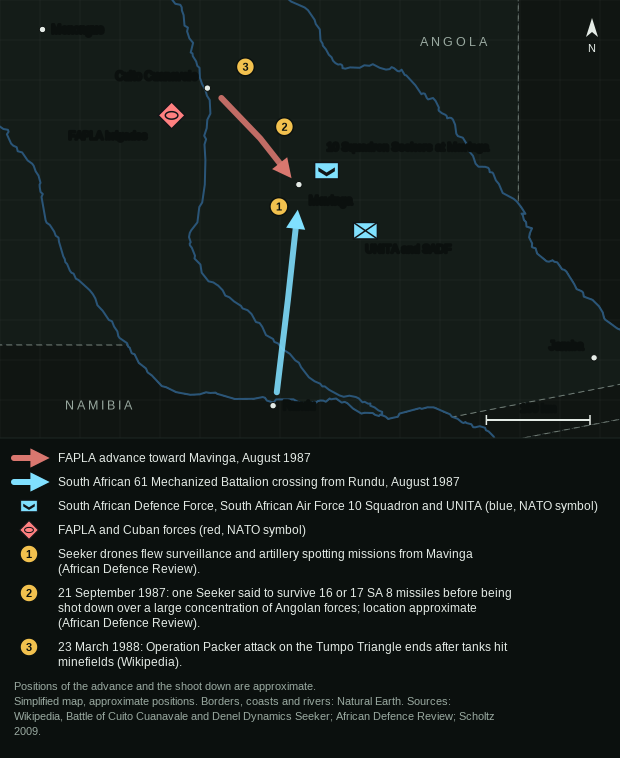
From 14 August 1987 to 23 March 1988, South Africa and UNITA fought the People's Armed Forces for the Liberation of Angola (FAPLA) and Cuba around Cuito Cuanavale in southeast Angola, as Wikipedia names the sides. South African Seeker drones of 10 Squadron, flown from Mavinga, watched the advancing Angolan brigades and the air defences that covered them. Darren Olivier of African Defence Review wrote that one Seeker survived 16 or 17 SA 8 missiles before it was shot down on 21 September 1987.
What happened
Wikipedia records that FAPLA began Operation Saluting October in August 1987, sending brigades south east from Cuito Cuanavale toward the UNITA base at Mavinga. The 16th, 21st, 47th and 59th brigades, about 6,000 men and 80 tanks, crossed toward the Lomba River and reached its north bank on 28 August. South Africa had launched Operation Modular on 4 August, when 61 Mechanized Battalion crossed from Rundu. Between 9 September and 7 October, South African and UNITA forces stopped FAPLA crossing the river, and FAPLA fell back more than 190 km. Operation Hooper followed, then Operation Packer, whose attack on the Tumpo Triangle on 23 March 1988 ended after tanks hit minefields. Wikipedia gives FAPLA losses of 4,768 dead and Cuban losses of 42 confirmed dead, and South African reports of 43 dead. Both sides claimed victory.
The drones
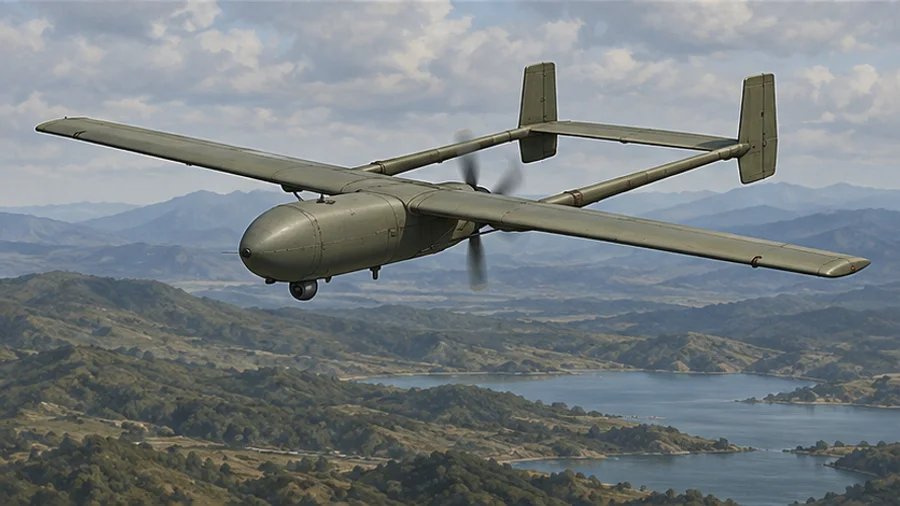
Wikipedia says the Seeker, built by Kentron, later Denel Dynamics, entered South African Air Force service in 1986 with 10 Squadron at Potchefstroom. Olivier wrote that the aircraft in the Seeker I system was the Seeker 2B, with a typical ceiling of 15,000 to 18,000 feet. Short range missions lasted 9 to 10 hours, and long range missions out to about 200 km lasted 4 to 5 hours. A crew of four flew each mission from a command truck, supported by 4 to 6 ground crew. DefenceWeb reported that 10 Squadron also flew Israeli IAI Scout drones across southern Africa, from Mozambique to Angola.
How they were used
Olivier wrote that the Seekers flew tactical surveillance and artillery spotting missions from Mavinga. Wikipedia adds that they gathered intelligence on enemy locations, movements and strength, and above all on static and mobile surface to air missile systems. South African Air Force intelligence used this to plan air strikes, interception routes and briefings that kept aircraft away from the missiles. Leopold Scholtz, in a 2009 analysis of the air war, quoted Brigadier General Dick Lord that the drones helped identify suitable targets as the Angolan brigades advanced through dense bush during the Lomba battles.
What effect they had
Wikipedia states that FAPLA and Cuban forces fired their costly 9K33 Osa (SA 8) missiles at the small drones, which used up missile stocks and let other South African aircraft fly with less risk. It reports about 17 missiles fired at one drone before it fell, and that only three drones were lost during the deployment. Scholtz gave the same count and noted they were cheap and carried no crew. Manned aircraft fared worse. Scholtz recorded that an SA 8 destroyed a Bosbok spotter aircraft on 3 September 1987, and that Major Ed Every was killed on 9 February 1988 when a missile hit Every's Mirage F1AZ.
Related battles
For the classroom
- Why did FAPLA and Cuban crews keep firing expensive SA 8 missiles at a slow, small drone?
- What could a Seeker crew learn about an advancing brigade that the pilot of a Mirage reconnaissance jet could not?
- How does losing a drone with no crew change a commander's willingness to fly over a defended area?
Sources
- Wikipedia: Battle of Cuito Cuanavale
- Wikipedia: Denel Dynamics Seeker
- A history of South African UAVs (African Defence Review, 2015)
- The air war over Angola, 1987 to 1988: an analysis (Scholtz, 2009)
- Seeker UAVs for the SAAF (defenceWeb)
Written 2026-10-04.