
Operation Protea
- When
- 23 August to early September 1981
- Where
- Cunene Province, Angola
- Sides
- South Africa vs SWAPO and Angola
- Drones
- IAI Scout, Tadiran Mastiff
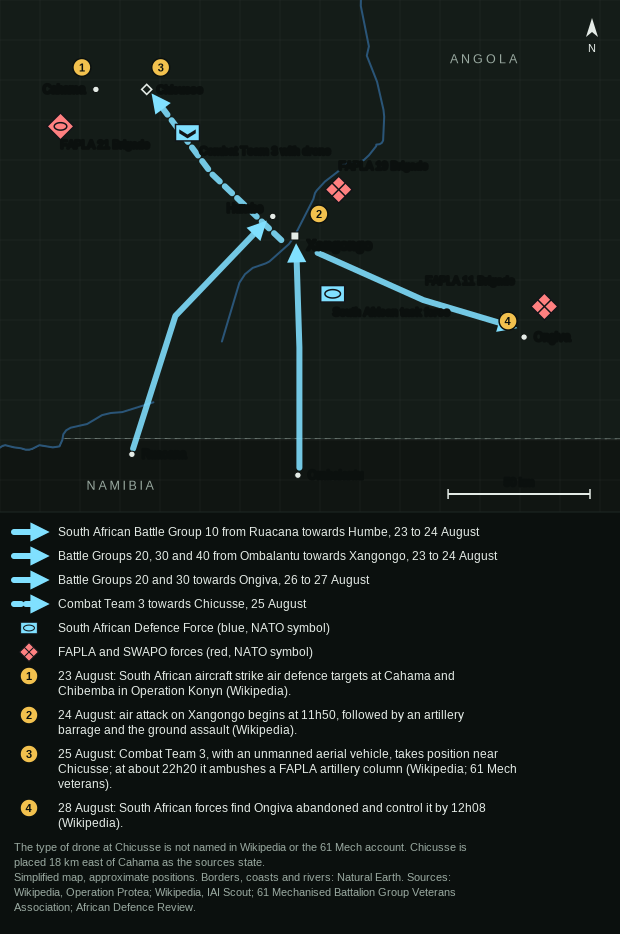
From 23 August to early September 1981, South African forces occupied Cunene Province in southern Angola in Operation Protea, and Wikipedia records that the IAI Scout drone was first flown in combat by the South African Defence Force during this operation. Wikipedia describes it as an attack by the South African Defence Force (SADF) on SWAPO bases, with Angolan government troops (FAPLA) also fighting. It places one unmanned aerial vehicle with a combat team near Chicusse on 25 August.
What happened
Wikipedia states that Protea began on 23 August 1981 with up to 5,000 SADF soldiers and aimed to destroy SWAPO bases at Xangongo and Ongiva. South African aircraft first struck air defence sites at Cahama and Chibemba in Operation Konyn. Battle groups crossed the border at Ruacana and Ombalantu that night. The air attack on Xangongo began at 11h50 on 24 August, and Battle Group 40 reached the Cunene bridge by 17h30. Ongiva was attacked on 27 August and found abandoned on 28 August. Wikipedia lists 10 South Africans dead and 64 wounded, 831 PLAN and FAPLA dead and 25 captured. It gives the end date as 2 September in its infobox and 4 September in its text.
The drones
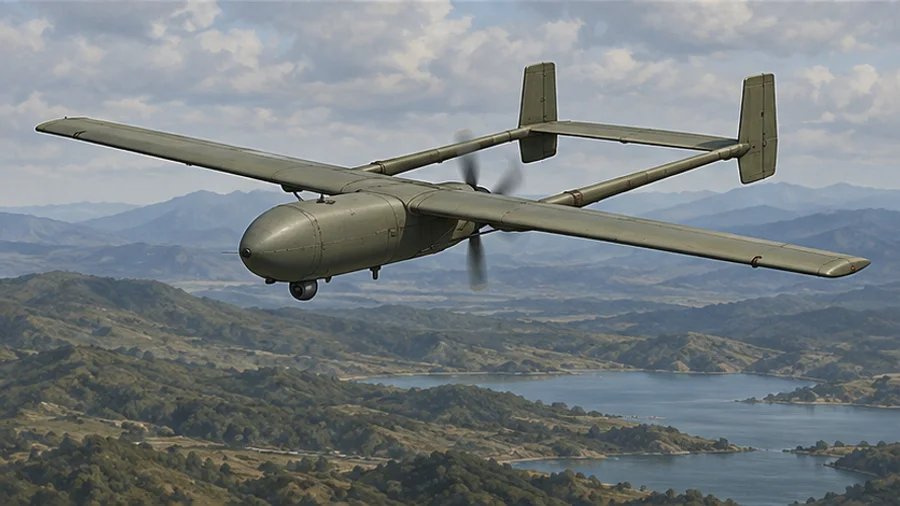
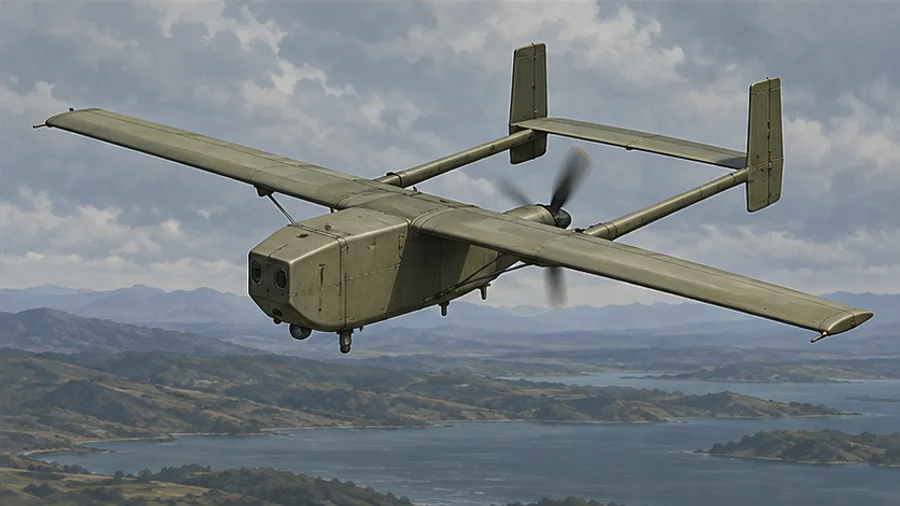
Wikipedia describes the Scout as a reconnaissance drone built by Israel Aircraft Industries in the 1970s as a competitor to the Tadiran Mastiff. The IAI Scout is 3.68 m long with a 4.96 m wingspan. Wikipedia lists a 38 kg payload, a 16 kW piston engine, a top speed of 176 km/h, an endurance of 7 hours 30 minutes and a ceiling of 4,600 m, with imaging sensors in a belly turret. Darren Olivier wrote in African Defence Review in 2015 that the South African Air Force bought its first five Scouts in 1980 and later flew more than a dozen.
How they were used
Wikipedia lists Combat Team 3, under Major Joe Weyers, as armoured car troops, infantry, four G 2 guns, engineers, an unmanned aerial vehicle and the pathfinders of Colonel Jan Breytenbach. On 25 August it took position near Chicusse, about 18 km from Cahama, to stop or delay any FAPLA move towards Xangongo. The 61 Mechanised Battalion Group Veterans Association says an unmanned aerial vehicle and a Bosbok light aircraft flew reconnaissance for the team. Neither names the type. Around 22h20 the artillery troop reported eight vehicles approaching from the south east. Wikipedia says this FAPLA artillery unit was ambushed and destroyed, with three South Africans wounded and two BM 21 rocket launchers captured. Olivier describes Scout work as surveillance and artillery spotting over defended airspace.
What effect they had
Olivier wrote that Scouts saw combat between 1980 and 1987, and that three were lost to surface to air missiles: on 30 March 1983 over Maputo, on 26 September 1987 and on 8 October 1987. Olivier added that the air force counted these as proof that light, slow drones survived missile fire, and that no crew died. Wikipedia says Israeli Scouts and Mastiffs helped locate Syrian missile sites in the Bekaa Valley in 1982, where all 28 were destroyed in Operation Mole Cricket 19. The veterans association account says a South African drone was shot down near Cahama in December 1983, and compares the Xangongo bridge with Cuito Cuanavale, which the SADF did not capture.
For the classroom
- Why would commanders send a drone with a small combat team blocking a road?
- How do the Scout's endurance and payload fit the surveillance and spotting role Olivier describes?
- What can historians say about the drone at Chicusse when two accounts mention it but neither names its type?
Sources
- Wikipedia: Operation Protea
- Wikipedia: IAI Scout
- A history of South African UAVs (African Defence Review, 2015)
- Operation Protea (61 Mechanised Battalion Group Veterans Association)
- Wikipedia: Cahama
- Wikipedia: Humbe
- Wikipedia: Ruacana
- Wikipedia: Outapi
- Wikipedia: Ondangwa
- Wikipedia: Xangongo
- Wikipedia: Ondjiva
Written 2026-10-04.