
Operation Mole Cricket 19
- When
- 9 to 10 June 1982
- Where
- Bekaa Valley, Lebanon
- Sides
- Israel vs Syria
- Drones
- Tadiran Mastiff, IAI Scout
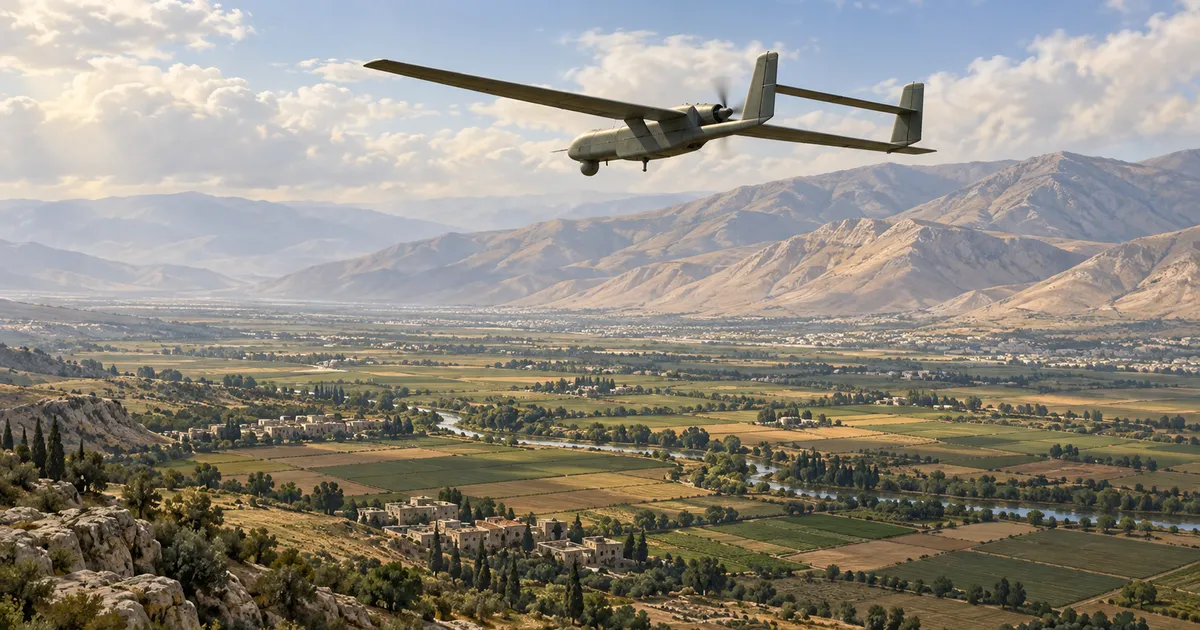
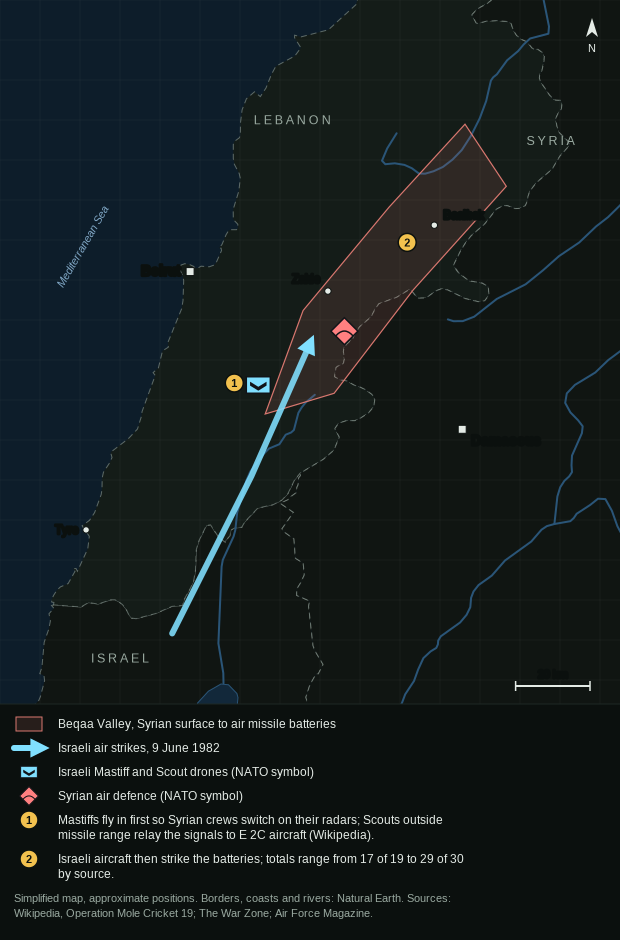
On 9 June 1982, during the 1982 Lebanon War, Israel used remotely piloted aircraft to find and provoke Syrian surface to air missile batteries in the Beqaa Valley, and manned Israeli aircraft then destroyed most of them in about two hours. Wikipedia names the sides as Israel (the Israeli Air Force) and Syria (the Syrian Arab Air Force). The drones did not destroy the batteries themselves. Their job was to make the Syrian radars switch on and to report what they saw.
What happened
According to Wikipedia, Operation Mole Cricket 19 was a suppression of enemy air defenses campaign against Syrian missile batteries in the Beqaa Valley. Rebecca Grant, writing in Air Force Magazine in 2002, describes the wider air battle as lasting about 46 hours, ending when a ceasefire took effect. Israeli commanders later disagreed about whether the clash had been planned in advance or had developed on the day, as Wikipedia notes.
The drones
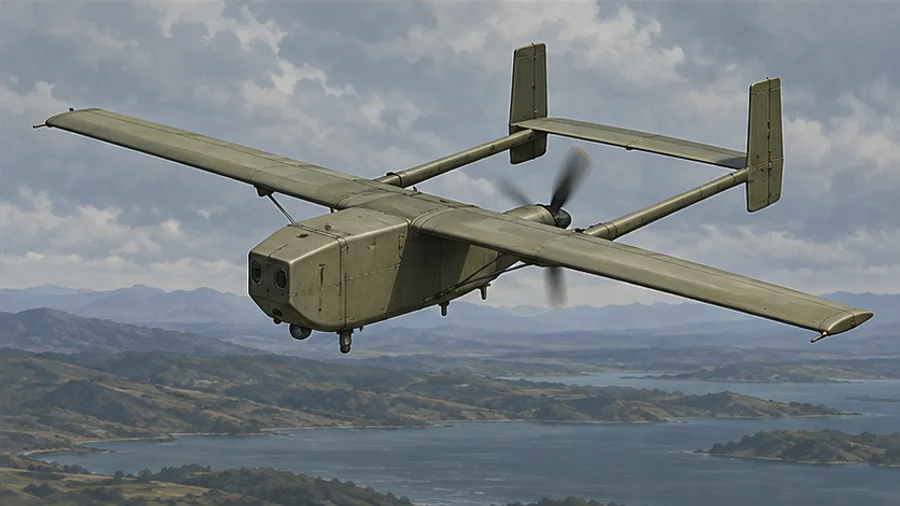
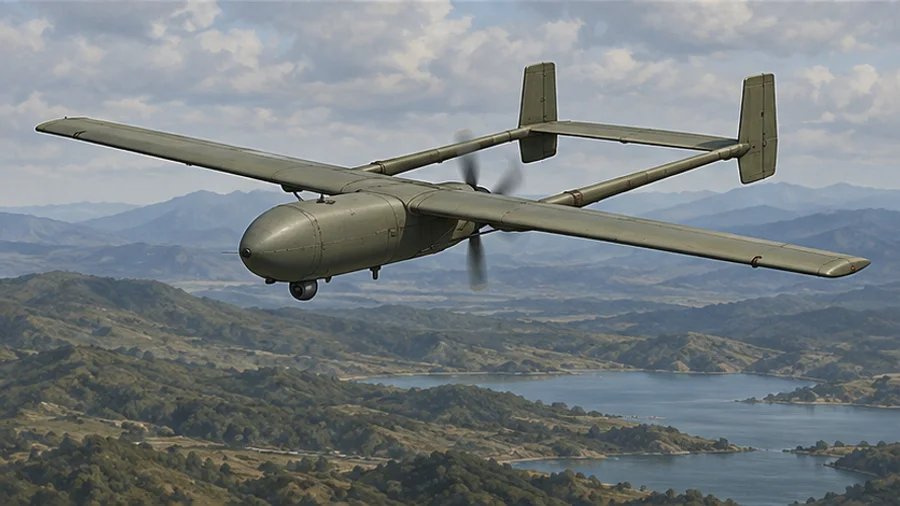
Israel flew two types of small propeller driven reconnaissance aircraft. Wikipedia gives the Tadiran Mastiff, which first flew in 1973, a length of 3.3 m, a wingspan of 4.25 m, a top speed of 185 km/h and an endurance of about 7.5 hours. The IAI Scout was 3.68 m long with a 4.96 m wingspan, a top speed of 176 km/h and a similar endurance. Wikipedia also records that the Samson, an unpowered winged decoy supplied to the Israeli Air Force in the 1970s, was used with success in the 1982 war.
How they were used
Grant’s reconstruction, including her interview with David Ivry, describes remotely piloted aircraft observing mobile missile batteries and helping maintain the command picture. It does not establish the precise Mastiff-to-Scout-to-Hawkeye relay chain reproduced in Wikipedia. Tyler Rogoway of The War Zone describes the drones as decoys that flooded Lebanese airspace and baited the Syrian air defences into exposing themselves to anti radiation missiles. Grant reports that Israel had one squadron of these aircraft and kept at least two airborne at a time to track mobile batteries.
What effect they had
Sources give different totals. Wikipedia reports 29 of 30 batteries destroyed in the first strikes and six more destroyed later. Rogoway writes that 17 of the 19 sites around the Beqaa were destroyed on the first day. Grant gives 19 batteries in two hours. The Wikipedia article on the IAI Scout says all 28 sites were destroyed, partly through reconnaissance from the Mastiff and Scout. Wikipedia lists one Israeli drone shot down and between 82 and 86 Syrian aircraft lost, with no Israeli aircraft lost in air combat. Soviet media claimed that 67 Israeli aircraft were downed, a claim Wikipedia says was met with great skepticism. Rogoway argues that the operation set a pattern Israel would refine in later decades: unmanned aircraft used to expose an air defence network so that manned aircraft can attack it.
Related battles
For the classroom
- Why would a missile crew switch on its radar for a small drone, and what did that cost them?
- The sources disagree on how many sites were destroyed. How should a historian handle figures that range from 17 to 30?
- The drones did not carry weapons. Can an unarmed aircraft still decide the result of an air battle?
Play this battle in the simulation
Take either side in the scenario built on this battle, with the same drones on a real map.
Sources
- Wikipedia: Operation Mole Cricket 19
- Meet Israel's Suicide Squad of Self Sacrificing Drones (The War Zone)
- The Bekaa Valley War (Air and Space Forces Magazine, 2002)
- Wikipedia: IAI Scout
- Wikipedia: Tadiran Mastiff
- Wikipedia: ADM 141 TALD (Samson)
Written 2026-10-03.