
FL-boat attacks off Flanders
- When
- 1 March and 28 October 1917
- Where
- Flanders coast, Belgium
- Sides
- Germany vs United Kingdom
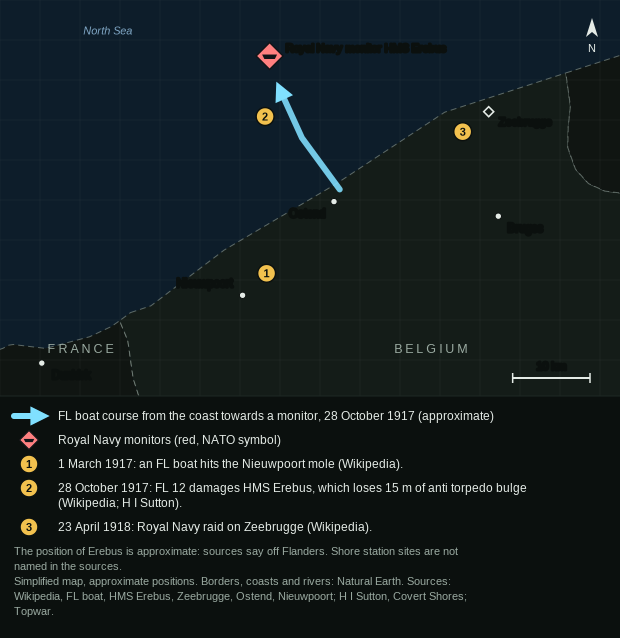
On 1 March and 28 October 1917, the Imperial German Navy used FL boats, remote controlled explosive motorboats, against targets on the Flanders coast of Belgium, where it faced the Royal Navy in the First World War. Wikipedia names the sides as the Imperial German Navy and the Royal Navy. One boat hit the Nieuwpoort mole and another damaged the monitor HMS Erebus, which survived.
What happened
Wikipedia records that on 1 March 1917 an FL boat hit the Nieuwpoort mole and that on 28 October 1917 one hit Erebus. Wikipedia's article on the ship says Erebus bombarded German naval forces based at the Belgian ports of Ostend and Zeebrugge. H I Sutton, writing on Covert Shores, says the boat that attacked Erebus was FL 12, the twelfth of seventeen built, and that it was the only attack that was at all successful. Wikipedia's article on Zeebrugge records that on 23 April 1918 the Royal Navy temporarily put the German naval base at Bruges out of action in a raid on that port.
The drones
Wikipedia lists the FL boat, in German Fernlenkboot, as built by Siemens Schuckertwerke, 17 m long, with a crew of none, a speed of 30 knots and a 700 kg explosive charge; 17 were completed. Sutton gives a length of 13 m and says it had two 210 horsepower Maybach petrol engines normally used for Zeppelins. The blog Standing Well Back, which covers historical explosive devices, repeats the 17 m figure and traces the idea to Werner Siemens in 1871, revived by Werner Siemens's son Wilhelm in 1905.
How they were used
Wikipedia says the boats were steered from a shore station through a spooled wire, 20 km long, unwound behind the boat, with the spool weighing 800 kg. An aircraft could signal directions to the shore station by radio. The operator's commands were a system test, engine start and stop, rudder position, a light so the boat could be tracked at night, and detonation of the warhead to prevent capture if it missed. Sutton says the distance at which the command post could steer accurately was too limited, so an aircraft was added as a spotter. Wikipedia lists planned developments of a control station on a ship or airship, or radio control. The Russian writer Vyacheslav Shpakovsky, on the site Topwar, says the boat that attacked Erebus left at 13:20, was steered by wire from the shore for 25 minutes, and was then directed at the monitor by the aircraft, which sent it in at 14:18.
What effect they had
Wikipedia records that the attack cost Erebus 50 ft (15 m) of anti torpedo bulge. The Erebus class had been fitted with these bulges on each side of the hull. Shpakovsky says the boat struck about the middle of the side, that it carried 230 kg of explosive rather than 700 kg, and that Erebus returned to base under its own power and was repaired in two weeks. Standing Well Back says the boats were not used often and that Erebus was damaged but not sunk. Sutton says the Germans found the FL boat an expensive and difficult weapon to apply and that the programme was abandoned in 1918.
Related battles
For the classroom
- Why did the Germans add an aircraft to the control chain of the FL boat?
- What does the loss of 15 m of bulge on Erebus show about a 700 kg charge, and what would a smaller charge change?
- Sources give the boat's length as 17 m and as 13 m; what records could settle it?
Sources
- Wikipedia: FL boat
- Wikipedia: HMS Erebus (I02)
- German remote control speedboats of WW1 and WW2 (Standing Well Back)
- A brief history of Explosive Boats (H I Sutton, Covert Shores)
- Monitor vs drones (Vyacheslav Shpakovsky, Topwar, 2023)
- Wikipedia: Ostend
- Wikipedia: Zeebrugge
- Wikipedia: Nieuwpoort, Belgium
- Wikipedia: Bruges
- Wikipedia: Dunkirk
Written 2026-10-04.