
Linse attacks off Normandy
- When
- Summer 1944, including the night of 2 to 3 August
- Where
- Normandy coast; later the Scheldt approaches
- Sides
- Germany vs Allied navies
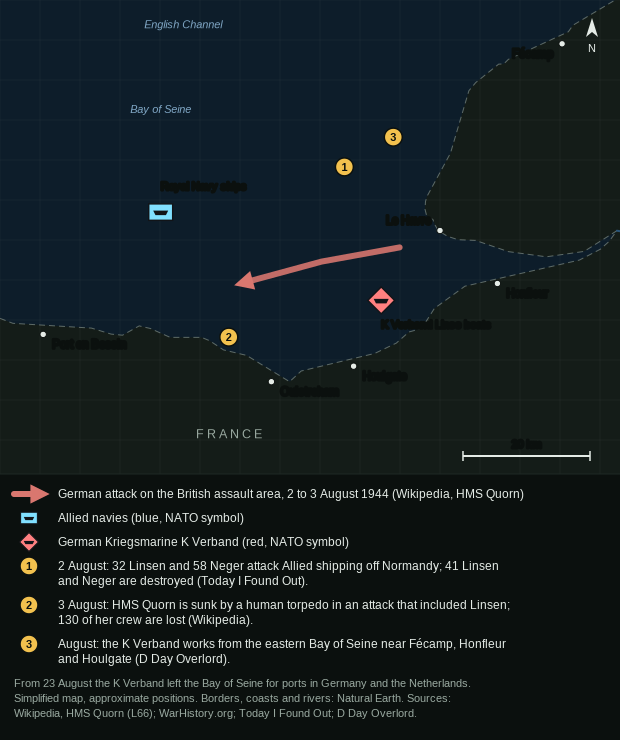
On the night of 2 to 3 August 1944 the German Kriegsmarine sent Linse explosive motorboats against the Allied invasion fleet off the Normandy coast. Each Linse was steered by radio in its last stage, after its pilot had jumped overboard. Wikipedia places the Linsen in the K Verband, the Kleinkampfverbände der Kriegsmarine or "small battle units", and the sides are Germany and the Allied navies. The destroyer HMS Quorn sank on 3 August during an attack that included Linsen, although Wikipedia records that a human torpedo hit her.
What happened
Wikipedia records that the K Verband was formed in April 1944. WarHistory.org says it took over the thirty existing Linsen after an order of 15 April 1944. Today I Found Out reports that on the night of 2 August 32 Linsen and 58 Neger human torpedoes attacked Allied shipping off Normandy, and that 41 Linsen and Neger were destroyed with no Allied vessel lost. Wikipedia's article on HMS Quorn records the destroyer as sunk on 3 August by a human torpedo piloted by Herbert Berrer, in an attack on the British assault area by E boats, Linsen, human torpedoes and low flying aircraft. It says 130 of her crew were lost. The D Day Overlord site says the K Verband worked in August from the eastern Bay of Seine near Fécamp, Honfleur and Houlgate, and left from 23 August for ports in Germany and the Netherlands.
The drones
Wikipedia states that Linsen were operated in units of three, two boats carrying 660 to 800 lb of explosive and a third controlling them in the final run. WarHistory.org gives the improved Linse as 5.75 m long, 1.2 tonnes, with a 95 hp Ford V8 engine, a top speed of 31 knots and a range of 80 sea miles at 15 knots. The command boat carried a Blaupunkt transmitter on the 7 metre band. WarHistory.org reports 1,201 boats built by the end of the war, 385 of them by October 1944.
How they were used
WarHistory.org describes the attack unit as a Rotte, one command boat and two Linsen. At night they approached at 12 knots, then ran at about 30 knots once the target was confirmed. The pilots primed the detonator, switched on the remote control and jumped out a few hundred metres short. The command boat crew then steered each empty Linse, lining up a red and a green lamp on its stern with the target. The orders included rudder, engine speed and detonation. Standing Well Back notes that the First World War Fernlenkboot used in the FL boat attacks off Flanders carried 700 kg and was steered by a cable.
What effect they had
The D Day Overlord site says the K Verband made eight attacks in August 1944 that "did not worry the Allied armada", and that the Kriegsmarine's overall impact against Allied naval forces in Normandy was almost nil. Today I Found Out reports that the Linse flotillas claimed eight ships sunk, among them a cruiser, two destroyers and two freighters, while nearly 70 boats and crews were lost. It names low speed, which left the boats exposed to gunfire, as a main weakness.
For the classroom
- Why did the Linse need a pilot and a radio operator in a second boat?
- Today I Found Out says no Allied ship was lost on 2 August, while Wikipedia says Quorn sank on 3 August: how could both be correct?
- What did low speed mean for a Linse attack on a fleet?
Sources
- Wikipedia: K Verband
- Wikipedia: HMS Quorn (L66)
- Wikipedia: Neger (torpedo)
- The Explosive Boats of the Kriegsmarine (WarHistory.org)
- The Insane Explosive Motorboats of WWII (Today I Found Out, 2026)
- History of the Kriegsmarine (D Day Overlord)
- German Explosive Remote Control speedboats of WW1 and WW2 (Standing Well Back)
Written 2026-10-04.