
Mistel attacks off Normandy
- When
- June 1944
- Where
- Seine Bay, Normandy
- Sides
- Germany vs Allied invasion fleet
On the night of 24 to 25 June 1944, during the Battle of Normandy, the Luftwaffe flew Mistel composite aircraft against the Allied invasion fleet in the Bay of the Seine, the first combat use of the weapon. Wikipedia names the sides as Germany and the Allied invasion fleet. A Mistel was an unmanned Junkers Ju 88 bomber packed with explosives and flown to its target by a fighter mounted on top. The pilots claimed hits, but Wikipedia says none match Allied records.
What happened
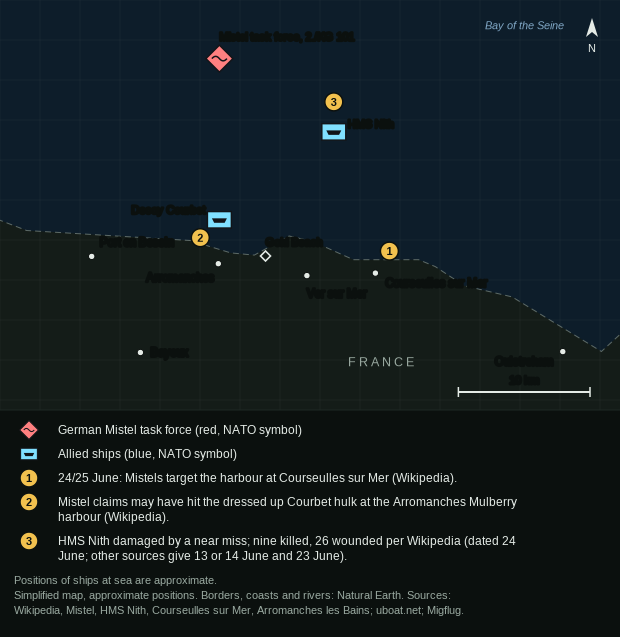
Wikipedia records that the Mistels targeted the British held harbour at Courseulles sur Mer. According to Wikipedia, Oberleutnant Horst Rudat led a task force of 2./KG 101 on the night of 24/25 June, and all Mistels were under the command of the test unit KG 200. WarHistory.org says the first operational Mistels reached 2/KG 101 in May 1944 and that the unit had been meant for Scapa Flow until the invasion changed the plan. Wikipedia counts four Mistels in Rudat's formation, while its KG 200 article says one Ju 88 was jettisoned early and four pilots launched. Migflug reports that German flak, not warned of the mission, hit Rudat's own aircraft.
The drones
Wikipedia describes the Mistel as the larger, unmanned part of a composite. A Ju 88 had its crew compartment replaced by a nose filled with explosives formed into a shaped charge, and a fighter was joined to it by struts. Migflug lists the fighter as a Bf 109 F 4 in the Mistel 1 and an Fw 190 A 8 in the Mistel 2 and 3. Wikipedia gives the warhead as nearly two tonnes, 1,800 kg, expected to penetrate up to seven metres of reinforced concrete; WarHistory.org gives 8,377 pounds. Wikipedia says about 250 Mistels of all kinds were built.
How they were used
Wikipedia states that the pilot flew the combination to the target, released the unmanned bomber and turned the fighter back to base. WarHistory.org says explosive bolts severed the connection once the lower aircraft had been aimed. Walter Dinsdale, a Royal Canadian Air Force Mosquito pilot, was the first to shoot one down over Normandy, Wikipedia records. In a newspaper account of 4 August 1944 Dinsdale called the composite lumbering and a "cinch to shoot down".
What effect they had
Wikipedia says the claimed hits may have been made against the hulk of the French battleship Courbet, part of the Mulberry harbour at Arromanches, which the Allies had dressed up as a decoy. The frigate HMS Nith, a floating headquarters coordinating landing ships off Courseulles, suffered serious blast and shrapnel damage from a near miss. Wikipedia's Mistel article dates this to 24 June and counts nine killed and 26 wounded, with Nith towed back to England. Its Nith article says 13 and 14 June, adds a tenth man who died of wounds and names Cowes as the repair yard. uboat.net says 23 June and 10 dead. WarHistory.org and Wikipedia's KG 200 article say the four launches sank several blockships, which the Mistel article contradicts. On 12 April 1945 Mistels attacked the Küstrin bridges with negligible damage, as covered in Mistel attacks on the Oder bridges.
For the classroom
- Why would a Mistel pilot find it hard to tell whether the lower aircraft hit a real ship or a decoy such as the Courbet?
- The sources give three dates and two casualty counts for the hit on HMS Nith. What records could settle it?
- What made a slow composite aircraft easy for a night fighter to shoot down?
Sources
- Wikipedia: Mistel
- Wikipedia: HMS Nith (K215)
- Wikipedia: Kampfgeschwader 200
- Wikipedia: Horst Rudat
- Kampfgruppe 200 Part II (WarHistory.org)
- Mistel: The Luftwaffe's Piggyback Bomber (Migflug)
- HMS Nith K 215 (uboat.net)
- Wikipedia: Courseulles sur Mer
- Wikipedia: Arromanches les Bains
- Wikipedia: Gold Beach
- Wikipedia: Port en Bessin Huppain
- Wikipedia: Ver sur Mer
- Wikipedia: Ouistreham
- Wikipedia: Bayeux
Written 2026-10-04.