
Mistel attacks on the Oder bridges
- When
- 12 April 1945 and later strikes
- Where
- Oder crossings, including Küstrin
- Sides
- Germany vs Soviet Union
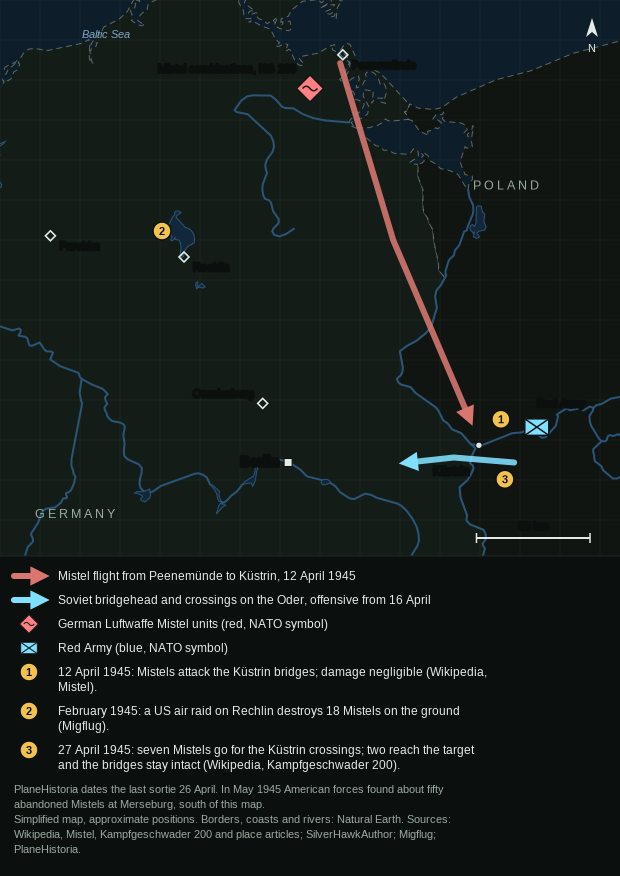
On 12 April 1945 the Luftwaffe sent Mistel composite aircraft against the bridges the Red Army was building across the Oder at Küstrin, and it flew further Mistel attacks against Oder crossings until late April. Wikipedia records that the damage was negligible and delayed Soviet forces for only a day or two. A Mistel was a worn bomber packed with explosives, flown to the target by a fighter fixed on top and then released to dive on its own.
What happened
Wikipedia records that the Mistels had been meant for Operation Iron Hammer, raids on power stations around Moscow and Gorky, but the Red Army had entered Germany before the plan could be flown, so the Luftwaffe used them against the Soviet bridgehead at Küstrin. PlaneHistoria reports that on 1 March 1945 the commander of KG 200 was told to destroy 120 bridges over the Oder, Neisse and Vistula. Wikipedia's article on KG 200 says that its Mistels were put under Oberst Joachim Helbig and that on 27 April seven Mistels under Leutnant Dittmann of II./KG 200, escorted by Fw 190 fighters, went for the Küstrin crossings. Only two reached the target, results were inconclusive and the bridges stayed intact. PlaneHistoria gives 26 April for this last sortie.
The drones
Wikipedia describes the Mistel as a modified Junkers Ju 88 bomber with its crew compartment replaced by a nose of explosives, topped by a fighter joined with struts. Wikipedia lists the Mistel 3 versions as a Ju 88 with an Fw 190 A 8 or F 8. The definitive warhead was a shaped charge of nearly two tonnes, which Wikipedia says was expected to penetrate up to seven metres of reinforced concrete. Wikipedia states that about 250 Mistels of various combinations were built. The weapon had first flown in combat against the Allied fleet in the Mistel attacks off Normandy of 1944. PlaneHistoria says the pilot released the fighter with explosive bolts.
How they were used
SilverHawkAuthor says the Mistels were unsuited to bridges. Their accuracy was inadequate for long narrow targets, and the shaped warheads blew holes without damaging a vital part of the structure. It describes the attack of 12 April: Leutnant Hans Altrogge led from Peenemünde at 1825 in a Ju 88 of I./KG 66, four Mistels followed, and Altrogge rocked the aircraft's wings over Küstrin as the signal to dive through heavy anti aircraft fire. The Küstrin bridges were pontoon bridges built by Soviet army engineers.
What effect they had
SilverHawkAuthor says Soviet records show the bridges stayed in use after the 12 April attack. The Red Army began its main offensive on 16 April and within two days had two bridgeheads on the west bank, one about 20 miles wide and one 30 miles wide, with more pontoon bridges thrown across the river. Wikipedia records the later Mistel attacks on Oder bridges as similarly ineffective. Migflug reports that a US air raid on Rechlin in February 1945 had already destroyed 18 of about 100 Mistels gathered near Berlin. PlaneHistoria says only two of the seven aircraft on the last sortie returned, II./KG 200 was disbanded the next day, and its men were put into infantry roles. PlaneHistoria says American forces found about fifty abandoned Mistels near the Junkers factory at Merseburg in May 1945.
For the classroom
- Why did pontoon bridges make a poor target for a weapon with a warhead built to break concrete?
- Wikipedia and PlaneHistoria give different dates for the last Mistel sortie. What records could settle it?
- What did the Luftwaffe lose by sending trained pilots and scarce airframes on these missions?
Sources
- Wikipedia: Mistel
- Wikipedia: Kampfgeschwader 200
- German Mistel composite aircraft (SilverHawkAuthor)
- Mistel: The Luftwaffe's Piggyback Bomber (Migflug)
- Mistel One of the Luftwaffe's Strangest Concepts (PlaneHistoria)
- Wikipedia: Kostrzyn nad Odrą
- Wikipedia: Peenemünde
- Wikipedia: Merseburg
- Wikipedia: Parchim
- Wikipedia: Rechlin
- Wikipedia: Berlin
- Wikipedia: Oranienburg
Written 2026-10-04.