
Operation Aphrodite and Operation Anvil
- When
- 4 August 1944 to 1 January 1945
- Where
- Occupied France, Germany and Heligoland
- Sides
- United States vs Germany
From 4 August 1944 to 1 January 1945, the United States Army Air Forces ran Operation Aphrodite, and from 12 August to 3 September 1944 the United States Navy ran a parallel project, Operation Anvil. Both loaded worn out bombers with explosives and steered them by radio toward German bunkers, V weapon sites and industrial targets. Wikipedia gives the locations as northern France and Germany and records the outcome of both operations as failure.
What happened
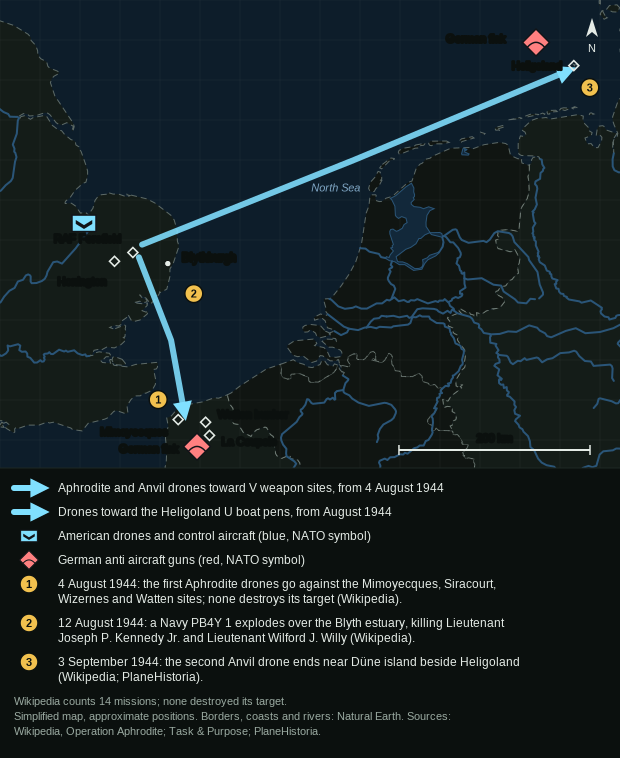
Wikipedia records that Major General Jimmy Doolittle, commander of the Eighth Air Force, approved Aphrodite on 26 June 1944 and gave the work to the 3rd Bombardment Division. The 562nd Bomb Squadron at RAF Honington prepared the aircraft, and RAF Fersfield in Norfolk became the launch site. The first missions on 4 August went against the Mimoyecques V 3 site, the Siracourt V 1 bunker, La Coupole at Wizernes and the Watten bunker. Later targets were the Heligoland U boat pens, the Heide oil refinery and, from late October, industrial sites in Germany. General Carl Spaatz ordered on 27 January 1945 that "Aphrodite babies must not be launched against the enemy until further orders", and Wikipedia gives 27 April 1945 as the formal end.
The drones
Wikipedia describes B 17E and B 17F bombers stripped of armament, armour and seats, which removed about 12,000 lb (5,400 kg). Azon radio control, named for "azimuth only", gave one axis of movement, so each drone needed two sets. Two television cameras sent the instrument panel and a forward view to a CQ 4 control aircraft. The load was British Torpex, which Wikipedia says is 50 percent more powerful than TNT; its infobox gives about 20,000 lb (9,100 kg). A replacement system called Castor was first used on 11 September 1944. The Navy used PB4Y 1 aircraft, the naval version of the B 24 Liberator.
How they were used
Radio control could not manage take off, so Wikipedia says a pilot and flight engineer flew each drone to 2,000 ft (600 m), handed control to the CQ 4 operators, armed the explosives and parachuted out through an enlarged hatch. Task & Purpose reported that the first control system had many problems and that Castor replaced it in September. With Castor the control aircraft flew at the drone's height, a couple of miles behind, and let the gap grow to about six miles on the final run. For Anvil the Navy supplied two Lockheed PV 1 controllers and a B 17 to receive the television picture.
What effect they had
Wikipedia counts 14 missions and says none destroyed its target. On the Heide mission in August, three drones failed to reach the target and the fourth crashed close enough to cause significant damage. Crews died as well: Wikipedia lists a pilot killed bailing out too low on 4 August and a pilot killed by the pilot's static line on 11 September. On 12 August a PB4Y 1 exploded over the Blyth estuary in Suffolk, killing Lieutenant Joseph P. Kennedy Jr. and Lieutenant Wilford J. Willy. PlaneHistoria said investigators later pointed to a possible fault in the arming system. On 3 September the Anvil drone missed Heligoland: Wikipedia says the controller flew it into a barracks near Düne island, while PlaneHistoria says it crashed on Düne without significant damage.
Related battles
For the classroom
- Why did the designers need a crew to fly each drone to 2,000 ft before handing over control?
- How did Castor and the new control aircraft positions try to fix the failures of the first missions?
- What do the two accounts of the 3 September Heligoland mission show about guiding a drone by television?
Sources
- Wikipedia: Operation Aphrodite
- The US tried to use bombers as attack drones in World War II (Task & Purpose)
- The Lethal Remote Controlled B 17 and B 24 Bombers (PlaneHistoria)
- Wikipedia: RAF Fersfield
- Wikipedia: Heligoland
- Wikipedia: Fortress of Mimoyecques
- Wikipedia: RAF Honington
- Wikipedia: Blythburgh
- Wikipedia: Blockhaus d'Éperlecques
- Wikipedia: La Coupole
Written 2026-10-04.