
STAG-1 assault drone strikes, Solomons
- When
- 27 September to 27 October 1944
- Where
- Bougainville and nearby Solomon Islands
- Sides
- United States vs Japan
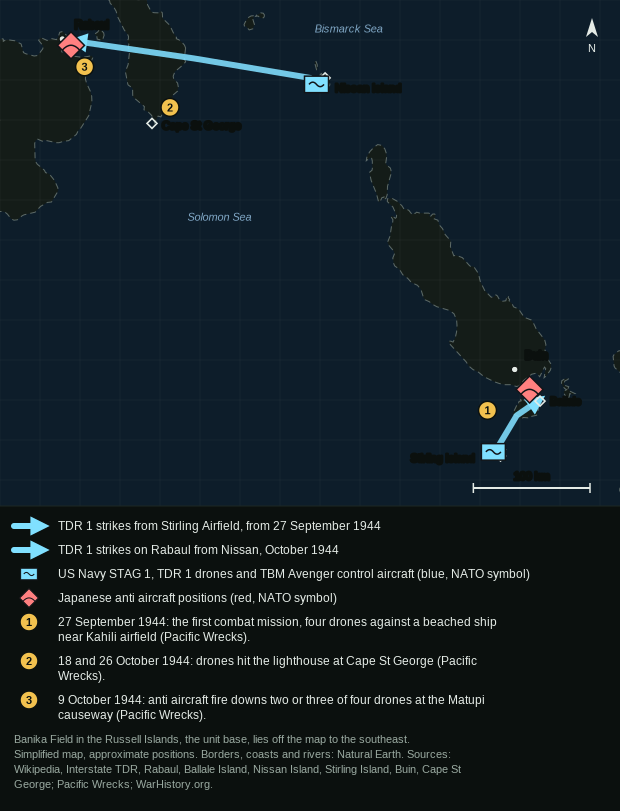
From 27 September to 27 October 1944, the United States Navy flew radio controlled Interstate TDR 1 assault drones against Japanese positions on southern Bougainville, the Shortland Islands and around Rabaul. Wikipedia names the unit as Special Task Air Group 1, known as STAG 1, and describes the operations as against the Japanese. Each drone carried a bomb and a television camera, and an operator in a following TBM Avenger steered it into the target.
What happened
Pacific Wrecks records that STAG 1 reached Banika Field in the Russell Islands on 12 June 1944 under Captain Robert F. Jones, and that on 30 July it staged a demonstration against the beached wreck of a Japanese freighter near Guadalcanal for Admiral Ernest Gunther. On 19 September a detachment moved to Stirling Airfield in the Treasury Islands. The first combat mission followed on 27 September, when four drones attacked a beached ship about a mile from Kahili airfield on southern Bougainville. On 1 October eight drones went against anti aircraft guns on Ballale, Poporang and southern Bougainville. From early October the detachment flew from Nissan Island, and strikes on Rabaul came on 5, 9, 15, 17 and 26 October. Pacific Wrecks says STAG 1 was deactivated on 27 October.
The drones
Wikipedia describes the TDR 1 as a twin engine drone with two 220 horsepower Lycoming O 435 engines, a 48 foot wingspan, a gross weight of 5,900 pounds, a cruise speed of 140 mph and a range of 425 miles. It carried one 2,000 pound bomb or one aerial torpedo. The frame was steel tube built by the Schwinn bicycle company under a molded wood skin. WarHistory.org adds an RCA television camera in the nose, a gyro stabilizer and a radar altimeter, and says a cockpit was kept for test and ferry flights and faired over for attacks. Wikipedia says 189 TDR 1 aircraft were produced out of 2,000 ordered.
How they were used
The operator in the Avenger watched the drone's camera picture and radar altimeter readout and dived it onto the target. In the July test Wikipedia says the control aircraft was 7 miles from the drone. Targets in October included the beached ships serving as gun positions off Kahili, gun emplacements on Ballale, supply caves at Keravia Bay, the Matupi causeway at Rabaul and a lighthouse at Cape St George. Pacific Wrecks lists many losses to control interference, screen failures and mechanical faults. On 9 October it says Japanese anti aircraft fire downed two or three of four drones, and the mission was judged a failure. WarHistory.org says a Navy motor gunboat's radio frequency interfered with two drones on 5 October. Pacific Wrecks adds that the Japanese recovered wreckage from at least one drone at Rabaul.
What effect they had
Wikipedia gives 50 drones expended, 31 successful strikes and no loss of STAG 1 pilots. WarHistory.org gives 46 drones expended, with 29 reaching the target areas. Pacific Wrecks counts 42 launched, or 45 in other accounts, with a claimed hit rate of 50 percent. Wikipedia records that the assault drone program had already been cancelled before the first mission, because of technical problems and because conventional weapons were proving adequate. WarHistory.org notes that the strikes led Tokyo Rose to broadcast stories about American suicide pilots.
Related battles
For the classroom
- Why did the operator in the Avenger depend on the drone's television picture to hit a target several miles away?
- Wikipedia, WarHistory.org and Pacific Wrecks give different counts of drones launched and hits. What might explain the gaps?
- Why would the Navy cancel a program whose strikes were still hitting targets?
Sources
- Wikipedia: Interstate TDR
- Special Task Air Group One, STAG 1 (Pacific Wrecks)
- Interstate TDR 1 assault drone (WarHistory.org, 2017)
- Wikipedia: Banika Field
- Wikipedia: Rabaul
- Wikipedia: Balalae Island
- Wikipedia: Nissan Island
- Wikipedia: Stirling Island
- Wikipedia: Buin, Papua New Guinea
- Wikipedia: Cape St George
Written 2026-10-04.