
Operation Linebacker II
- When
- 18 to 29 December 1972
- Where
- Hanoi and Haiphong
- Sides
- United States vs North Vietnam
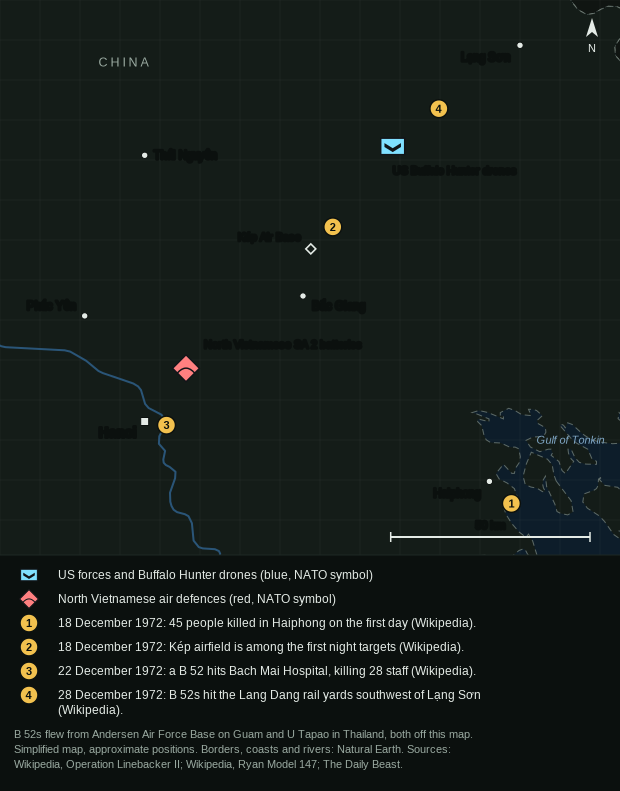
From 18 to 29 December 1972 the United States Air Force, Navy and Marine Corps bombed military and industrial targets in North Vietnam, mainly around Hanoi and Haiphong, in Operation Linebacker II. Wikipedia names the sides as the United States and North Vietnam. Wikipedia's article on the Ryan Model 147 says that in December 1972 the Air Force depended almost entirely on Buffalo Hunter AQM 34L and AQM 34M remotely piloted aircraft for bomb damage assessment because of bad weather.
What happened
Wikipedia records that peace talks broke down on 16 December and that President Nixon ordered the bombing on 18 December. The United States had 207 B 52 bombers in the region, 54 at U Tapao in Thailand and 153 at Andersen Air Force Base on Guam. On the first night 129 bombers took off, and their targets included the airfields at Kép and Phúc Yên and the Yên Viên warehouse complex. North Vietnamese batteries fired 68 SA 2 missiles and shot down three B 52s. After a 36 hour Christmas stand down, 120 bombers flew on 26 December, 78 of them from Andersen. Nixon suspended operations north of the 20th parallel on 30 December.
The drones
Wikipedia says Strategic Air Command's Buffalo Hunter program flew drones for low altitude photographic reconnaissance in Southeast Asia, particularly of airfields and suspected SAM sites. The Model 147SC (AQM 34L) entered service in January 1969, and Wikipedia says it flew almost half of all Lightning Bug missions. The Model 147SD (AQM 34M) was in service in 1972, and Wikipedia says 87 were built. Wikipedia lists the Model 147S at 13 feet (4.0 m) in wingspan and 29 feet (8.8 m) long, costing about $160,000, with a camera that could image a strip of land 60 miles (97 km) long. Designation Systems says the AQM 34L and M could fly as low as 60 to 150 m. The wider program is covered in Lightning Bug campaign over North Vietnam.
How they were used
Wikipedia says the Model 147 was launched from a larger aircraft or by rocket booster and came down on a parachute that a helicopter could catch in mid air. David Axe, in an excerpt from Axe's book Drone War: Vietnam published by The Daily Beast, wrote that the resumption of bombing in 1972 led Model 147s to fly bomb damage assessment missions that photographed the damage left by B 52 formations. Axe also wrote that drones collected signals from North Vietnam's Fan Song radars so the Air Force could update its jammers. WarHistory.org gives a record rate of 570 Firebee sorties in 1972, the year of the Linebacker raids, and 444 in 1973.
What effect they had
Wikipedia reports that the Paris Peace Accords were signed on 27 January 1973 and that both sides claimed victory in the campaign. Its lead says the United States acknowledged losing 16 B 52s and North Vietnam claimed 34. Wikipedia reports that official North Vietnamese sources counted 1,624 civilians killed, 1,328 in Hanoi and 306 in Haiphong, and that a B 52 hit Bach Mai Hospital on 22 December, killing 28 staff. Axe called Linebacker II the swan song of the first generation of combat drones. WarHistory.org counts 1,016 Lightning Bugs flying 3,435 missions during the whole war, with 578 lost to enemy action or accident.
For the classroom
- Why would bad weather make a low flying camera drone useful after a night raid?
- What did the Air Force want from drones that collected Fan Song radar signals before the B 52 raids began?
- How do the US and North Vietnamese figures for B 52 losses differ?
Sources
- Wikipedia: Operation Linebacker II
- Wikipedia: Ryan Model 147
- Inside Vietnam's Forgotten Drone War (The Daily Beast, David Axe)
- Ryan Aeronautical Firebee Drones II (WarHistory.org)
- Teledyne Ryan AQM BQM MQM 34 Firebee (Designation Systems)
- Wikipedia: Hanoi
- Wikipedia: Haiphong
- Wikipedia: Kép Air Base
- Wikipedia: Phúc Yên
- Wikipedia: Thái Nguyên (city)
- Wikipedia: Bắc Giang
- Wikipedia: Lạng Sơn (city)
- Wikipedia: Bạch Mai Hospital
- Wikipedia: Bach Mai Airfield
- Wikipedia: U Tapao Royal Thai Navy Airfield
Written 2026-10-04.