
Lightning Bug campaign over North Vietnam
- When
- 11 October 1964 to 1975
- Where
- North Vietnam, also China and North Korea
- Sides
- United States vs North Vietnam
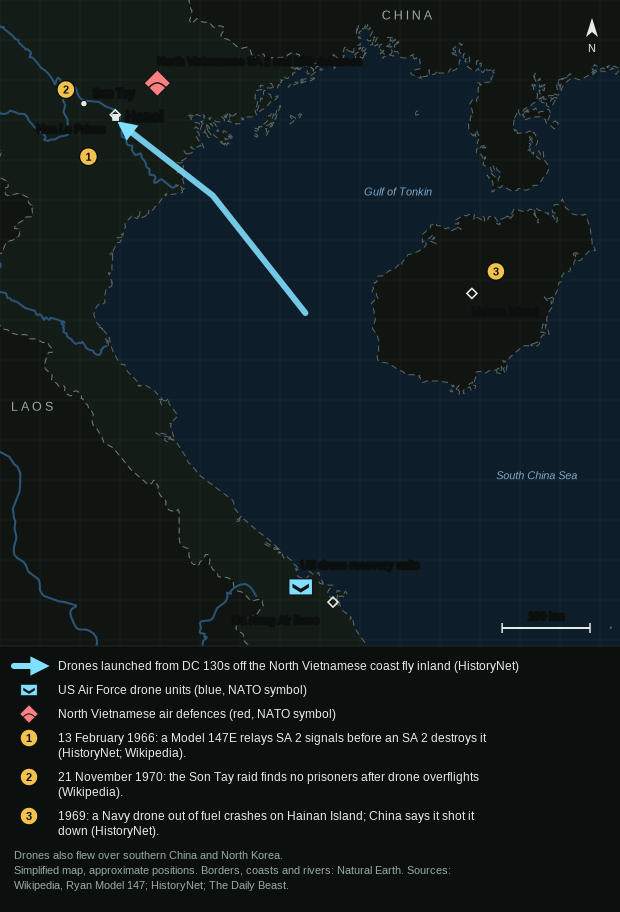
From 1964 to 1975 the United States Air Force flew unmanned Ryan Model 147 Lightning Bug drones over North Vietnam, southern China and North Korea to photograph and listen to air defences without risking aircrew. Wikipedia counts 3,435 sorties against those three countries. Its first mission from Bien Hoa Air Base in South Vietnam to cover the north took place on 11 October 1964, and HistoryNet says the last drone mission was flown in June 1975.
What happened
HistoryNet writes that President Lyndon Johnson ordered strategic reconnaissance assets to the Western Pacific on 4 August 1964, after the Gulf of Tonkin incident, and that the 4080th Strategic Reconnaissance Wing set up at Kadena Air Base on Okinawa. Wikipedia dates the first mission to 20 August 1964 and says two of five early flights over China succeeded. The drones moved to Bien Hoa in October. Wikipedia counts 77 flights in 1965 and 105 in 1966. HistoryNet says the 4080th became the 100th Strategic Reconnaissance Wing in February 1966 and that the drone unit moved to U Tapao in Thailand in July 1970. The campaign sat beside the wider Operation Linebacker II bombing in December 1972.
The drones
Wikipedia says the Model 147 was developed from the Firebee target drone, had no landing gear, and was launched from a DC 130 Hercules or by rocket booster. A recovery parachute let a helicopter catch it in mid air. The Model 147B had a 27 foot (8.2 m) wingspan and a ceiling of 62,500 feet. The low altitude Model 147S had a 13 foot (4.0 m) wingspan, a length of 29 feet (8.8 m) and cost about $160,000. Wikipedia says the Model 147SC, called Buffalo Hunter by its crews and in service from January 1969, flew almost half of all missions.
How they were used
On 13 February 1966 a Model 147E sniffer drone was destroyed by an SA 2 missile after it relayed the missile's signals, which HistoryNet says were picked up by an aircraft over the South China Sea. Wikipedia says decoy Model 147N drones began flying on 3 March 1966, after four of every five drones were failing to return. Wikipedia reports that drones photographed the Son Tay prison camp before the raid of 21 November 1970 found no prisoners. HistoryNet says drones also dropped chaff and leaflets. Wikipedia says that during Linebacker II the Air Force relied almost entirely on Buffalo Hunter drones to assess bomb damage. HistoryNet reports that a Navy drone launched from USS Ranger in 1969 crashed on Hainan Island, and China said it had shot it down.
What effect they had
Wikipedia states that 578 drones were lost, over half shot down. HistoryNet gives 544, with about one third lost to mechanical failure. WarHistory.org counts 1,016 drones flown, and David Axe in The Daily Beast counts 1,106. Wikipedia notes that no American crews were lost in the shoot downs. HistoryNet says seven North Vietnamese fighters were lost chasing drones, most of them to friendly fire. Axe reports that from 1967 North Vietnam intercepted the operators' radio signals and set ambushes, and the Air Force and National Security Agency added encryption. The historian William Wagner estimated the drones saved scores of pilots, Axe writes. Other flights near China are covered in US drone overflights of China.
For the classroom
- Why did the United States prefer unmanned aircraft over China in 1964, according to HistoryNet?
- How did the 13 February 1966 flight use an enemy missile launch to gather intelligence?
- Wikipedia counts 578 drones lost and HistoryNet 544. What might explain a gap like that?
Sources
- Wikipedia: Ryan Model 147
- Lightning Bug War Over North Vietnam (HistoryNet)
- Inside Vietnam's Forgotten Drone War (The Daily Beast, 2021)
- Ryan Aeronautical Firebee Drones II (WarHistory.org)
- Wikipedia: Da Nang Air Base
- Wikipedia: Hanoi
- Wikipedia: Sơn Tây, Hanoi
- Wikipedia: Hainan
- Wikipedia: Hỏa Lò Prison
Written 2026-10-04.