
US drone overflights of China
- When
- August 1964 to April 1965
- Where
- People's Republic of China
- Sides
- United States vs China
Between August 1964 and April 1965, the United States flew Ryan Model 147 Lightning Bug reconnaissance drones over southern China, and China shot some of them down. Wikipedia names the sides as the United States and China. Wikipedia records that no American crews were lost in the shoot downs, because the aircraft carried none.
What happened
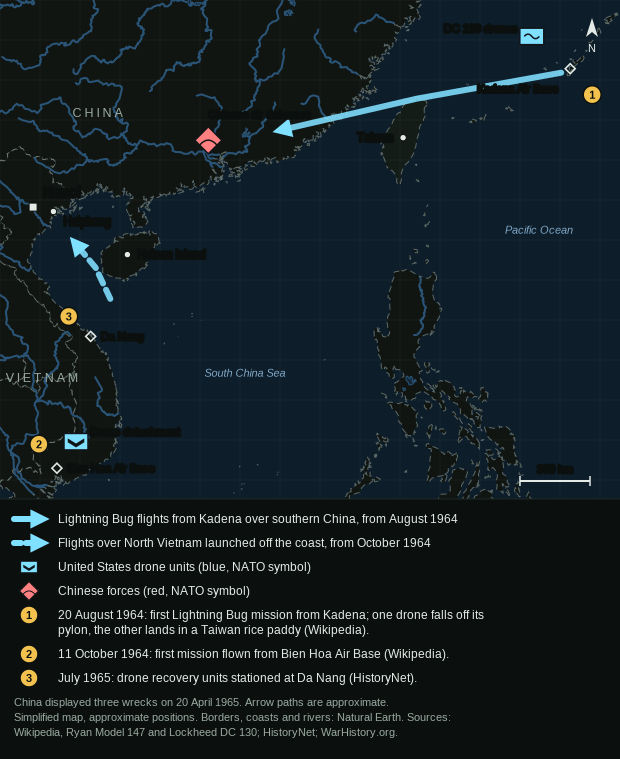
Wikipedia records that after the Gulf of Tonkin incident of 2 August 1964, the Johnson administration feared Chinese intervention in the widening war and decided to use the Lightning Bugs to monitor Chinese activities. HistoryNet, writing about the 4080th Strategic Reconnaissance Wing, says President Lyndon Johnson ordered reconnaissance assets to the Western Pacific on 4 August and that the wing set up at Kadena Air Base on Okinawa 48 hours later. Wikipedia dates the first mission to 20 August 1964. In early October 1964 the operation moved to Bien Hoa Air Base in South Vietnam, and the first mission from there flew on 11 October. Wikipedia says the Chinese destroyed one drone on 15 November 1964.
The drones
Wikipedia describes the Model 147B as the high altitude version of the Firebee target drone, with a wingspan of 8.2 m, up from 4.0 m on the Model 147A, and an operational ceiling of 19.1 km. HistoryNet says the 4080th's drone detachment had two DC 130A launch aircraft and eight Fire Fly drones, and that each DC 130A carried two Model 147 reconnaissance drones. Wikipedia says a DC 130 could carry four. At the end of a mission the drone deployed its parachute, and a helicopter was meant to catch it.
How they were used
The DC 130 carried the drones out and launched them in flight, and the drones photographed targets in southern China. On the first mission, 20 August 1964, Wikipedia says one drone failed to launch and fell off its pylon, while the second finished its flight, returned to Taiwan and landed by parachute in a rice paddy. The parachute dragged it across the ground and damaged it, but the film survived. Wikipedia counts five China missions into early September 1964, with two successful; HistoryNet says the first seven missions from Kadena produced two reels of usable film, which nearly ended the program. WarHistory gives the operation the name BLUE SPRINGS. Wikipedia says the Nationalist Chinese were enthusiastic about the drones, since their own U 2 flights over the mainland were meeting losses to S 75 missiles.
What effect they had
Wikipedia records that the Chinese destroyed five drones by mid April 1965 and displayed the wrecks of three on 20 April 1965. China's press called each one a "great victory" over United States reconnaissance planes. The United States answered with "no comment," and Wikipedia says the American press paid little attention because no crew had been captured. WarHistory says the three displayed drones were meant to embarrass the American government. It also says the wrecks gave China material to reverse engineer the Model 147B into its first indigenous target drone, and Wikipedia says recovered drones were used to build the Wu Zhen 5, which first flew in 1972. The October 1964 move to Bien Hoa came before the first shoot down, to widen flights over North Vietnam, and the story continues in the Lightning Bug campaign over North Vietnam.
Related battles
For the classroom
- Why did the Johnson administration prefer drones to crewed aircraft for flights over China in 1964?
- What went wrong on the first Lightning Bug mission of 20 August 1964, and how did it affect the program?
- How did China use the wrecks it displayed on 20 April 1965?
Sources
- Wikipedia: Ryan Model 147
- Lightning Bug War Over North Vietnam (HistoryNet)
- Ryan Aeronautical Firebee Drones I (WarHistory.org)
- Wikipedia: Lockheed DC 130
Written 2026-10-04.