
Operation Senior Bowl
- When
- 9 November 1969 to 20 March 1971
- Where
- Lop Nor test site and Yunnan, China
- Sides
- United States vs China
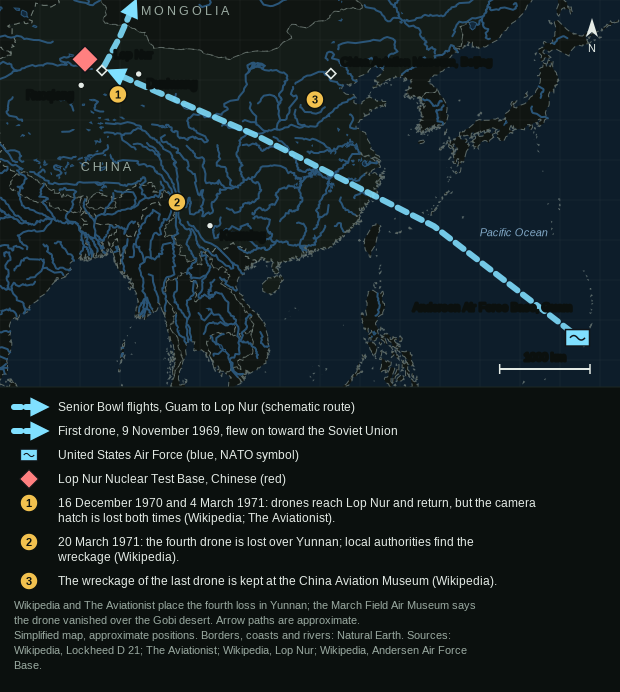
From 9 November 1969 to 20 March 1971, the United States flew at least four Lockheed D 21B reconnaissance drones toward the Lop Nur nuclear test site in China under the code name Senior Bowl, and no camera hatch was recovered as planned. Wikipedia names the sides as the United States and China. The drones flew at Mach 3 and were launched from B 52H bombers.
What happened
Wikipedia records that the US Air Force 4200th Support Squadron flew the missions from Beale Air Force Base in California, usually launching from Andersen Air Force Base on Guam. The first mission, on 9 November 1969, ended when the drone failed to turn around and kept flying until it crashed in the Soviet Union. The second, on 16 December 1970, reached Lop Nur and returned to the recovery point, but the parachute of the camera hatch partly failed and the hatch was lost at sea. On 4 March 1971 the drone again reached Lop Nur and released its hatch, but the midair recovery failed. The program was cancelled on 23 July 1971.
The drones
Wikipedia lists the D 21B at 13.06 m long with a wingspan of 5.80 m and a gross weight of 4,990 kg. It had one Marquardt RJ43 ramjet, a maximum speed of Mach 3.35, a ceiling of 29,000 m and a range of 5,600 km. A solid rocket booster, 14 m long and 6,000 kg, burned for 87 seconds to bring it to ramjet speed. Andreas Parsch's directory of US missiles says 38 D 21 and D 21B drones were built and 21 were expended. The Aviationist, an aviation news site, says each of two modified B 52H bombers carried two drones, with the second as a backup.
How they were used
The Aviationist reports that the bomber flew by night and launched the drone at about 40,000 feet, beyond the reach of Chinese early warning radar. The first drone climbed to 84,000 feet at Mach 3.27 and then disappeared over China. Wikipedia says a JC 130 Hercules was to snag the hatch in the air. After the 4 March 1971 failure, Wikipedia says the destroyer sent to retrieve the hatch ran it down and it sank. Wikipedia and The Aviationist say the fourth drone was lost over Yunnan; the March Field Air Museum says it vanished into the Gobi desert.
What effect they had
Wikipedia says the Chinese government never reported seeing a D 21B in flight. Parsch writes that only the second and third drones completed their flights and that the hatch could not be recovered either time. The Aviationist says the program never produced a single image of sensitive areas of China, while Wikipedia reports a writer, Lloyd Spanberger, citing Lieutenant Colonel Alfred Crane on two film capsules, one of which yielded usable photographs. Wikipedia gives the reasons for cancellation as the poor success rate, new satellites and President Nixon's rapprochement with China. Local authorities in Yunnan found the last drone's wreckage, now in the China Aviation Museum in Beijing. Wikipedia says the Soviet Tupolev bureau studied the drone lost in 1969 and drew up plans for a copy, the Voron, that was never built.
Related battles
For the classroom
- Why did the designers have the drone eject a camera hatch for recovery instead of landing?
- Which failures in the four missions came from the drone and which from the recovery system?
- Why might accounts of the fourth flight disagree about where the drone was lost?
Sources
- Wikipedia: Lockheed D 21
- The Secretive D 21 Drone and Operation Senior Bowl (The Aviationist, 2025)
- Lockheed D 21 Tagboard (Directory of US Military Rockets and Missiles, Andreas Parsch)
- D 21 Drone (March Field Air Museum)
- Wikipedia: Lop Nur
- Wikipedia: Andersen Air Force Base
- Wikipedia: China Aviation Museum
- Wikipedia: Yunnan
- Wikipedia: Dunhuang
- Wikipedia: Ruoqiang County
Written 2026-10-04.