
Operation Olive Branch
- When
- 20 January to 18 March 2018
- Where
- Afrin, Syria
- Sides
- Turkey and Syrian National Army vs YPG and SDF
- Drones
- Bayraktar TB2, TAI Anka
From 20 January to 24 March 2018, Turkey and allied Syrian rebel factions attacked the Afrin district of Aleppo Governorate, which the YPG held, and took Afrin city on 18 March. Wikipedia names the sides as Turkey, the Syrian Interim Government and other rebel factions against the Democratic Federation of Northern Syria, with the Syrian Arab Republic listed on the Kurdish side from 20 February to 21 March. Carnegie Europe records that the operation included the first use of Bayraktar TB2 drones in Syria.
What happened
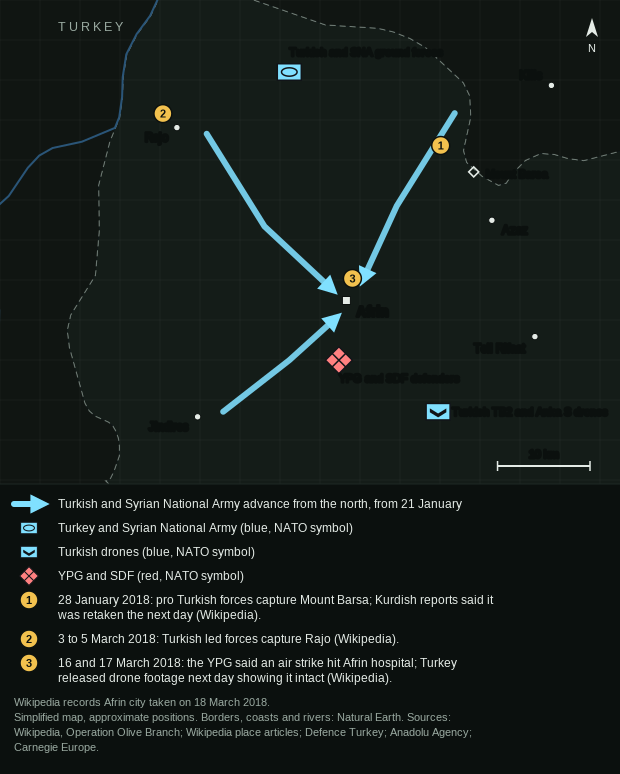
Wikipedia records that the Turkish General Staff announced the operation on 20 January, when fighter jets struck the border district, and that ground forces entered on 21 January. Turkish backed forces took Mount Barsa on 28 January; Kurdish reports said it was retaken the next day, which Turkey disputed. Pro government militias entered Afrin on 20 February. Turkish led forces captured Rajo between 3 and 5 March, took Jindires and the Afrin Dam on 8 and 9 March, and surrounded Afrin city by 13 March. The ground attack on the city began on 17 March, and Turkish forces posted pictures from its centre on 18 March.
The drones
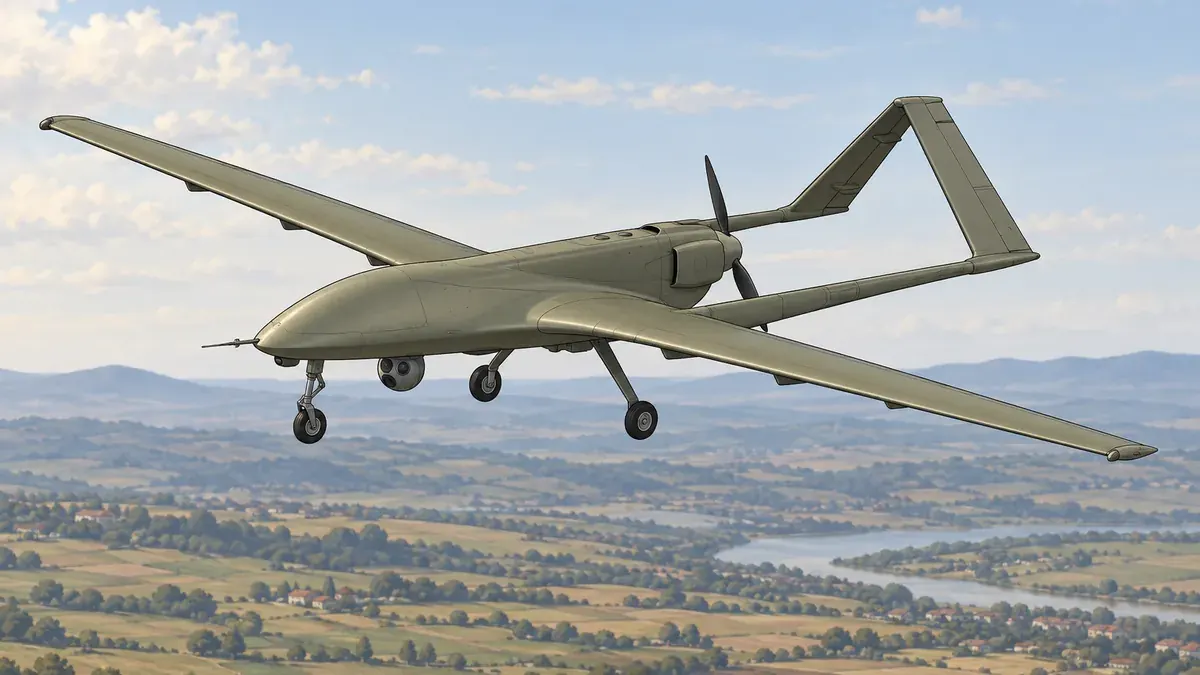
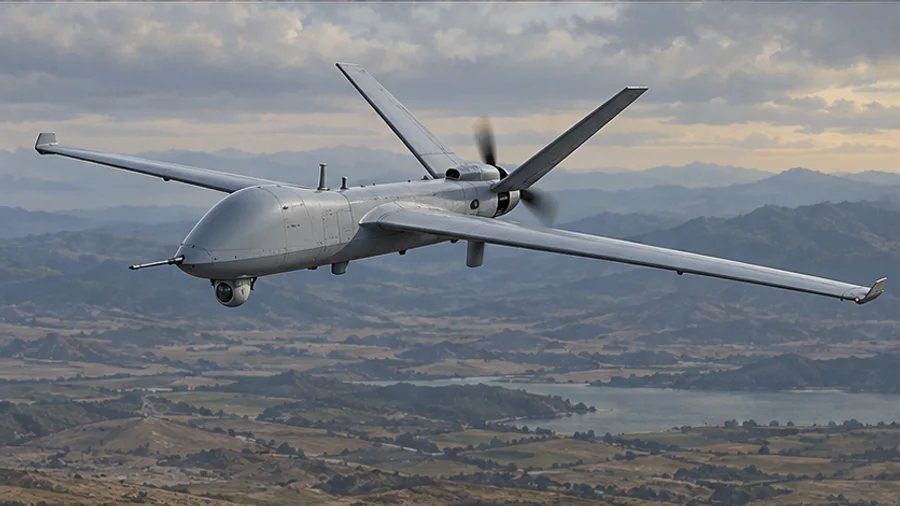
Wikipedia lists the Bayraktar TB2 at 6.5 m long with a 150 kg payload, a service ceiling of 7,620 m and an endurance of more than 20 hours. Can Kasapoglu of the Centre for Economics and Foreign Policy wrote in an Anadolu Agency piece that Turkey had drones from mini systems to satellite controlled Anka S aircraft. Defence Turkey magazine said a TB2 usually carries two MAM L and two MAM C micro munitions, and that in Olive Branch it flew with four MAM L for the first time because the operation area was close to its base. It gave the MAM L as about 1 m long and 22 kg, with an effective range of 8 km.
How they were used
Defence Turkey wrote that drones supplied tactical intelligence and fire support, located caves and tunnels, and flew at heights from 300 m to 25,000 ft in snow, rain and fog. Kasapoglu wrote that drones worked with artillery and rocket launchers against armed convoys heading for Afrin. Wikipedia reports Turkish sources saying Russia closed Syrian airspace to Turkey from the night of 4 February and that Turkish armed drones could still operate over Afrin; it reopened to Turkish jets on 9 February. Anadolu Agency figures cited by Defence Turkey give 382 TB2 sorties and 4,916 flight hours. On 16 March the YPG said an air strike hit Afrin's main hospital and killed 16 civilians; Turkey denied it and released drone footage of the hospital intact.
What effect they had
Human Rights Watch cited three attacks in the offensive that killed 26 civilians, 17 of them children, and said Turkey failed to take necessary precautions. UN High Commissioner Zeid Ra'ad Al Hussein said scores of civilians were killed in Afrin city. Wikipedia gives 150,000 to 300,000 civilians displaced. Carnegie Europe's Francesco Siccardi wrote that drones have been a fundamental part of Turkish operations in Syria since Olive Branch, including Operation Peace Spring and Operation Spring Shield, and that Turkish drones also altered the course of the Western Libya campaign.
For the classroom
- Why would drones help ground troops advancing into Afrin while Syrian airspace was closed to Turkish jets?
- Why did flying close to its base let a TB2 carry four MAM L munitions instead of two?
- How could drones find caves and tunnels for artillery and rocket launchers to strike?
Sources
- Wikipedia: Operation Olive Branch
- How Syria Changed Turkey's Foreign Policy (Carnegie Europe, 2021)
- Military scorecard of Operation Olive Branch (Anadolu Agency, 2018)
- Transformation of UAVs from a reconnaissance surveillance platform to a force multiplier in Turkey (Defence Turkey)
- Wikipedia: Bayraktar TB2
- Wikipedia: Afrin, Syria
- Wikipedia: Azaz
- Wikipedia: Jindires
- Wikipedia: Rajo, Syria
- Wikipedia: Mount Barsa
- Wikipedia: Kilis
- Wikipedia: Reyhanli
- Wikipedia: Tell Rifaat
Written 2026-10-04.