
Operation Outward
- When
- 20 March 1942 to September 1944
- Where
- Launched from Suffolk and Kent over Germany
- Sides
- United Kingdom vs Germany
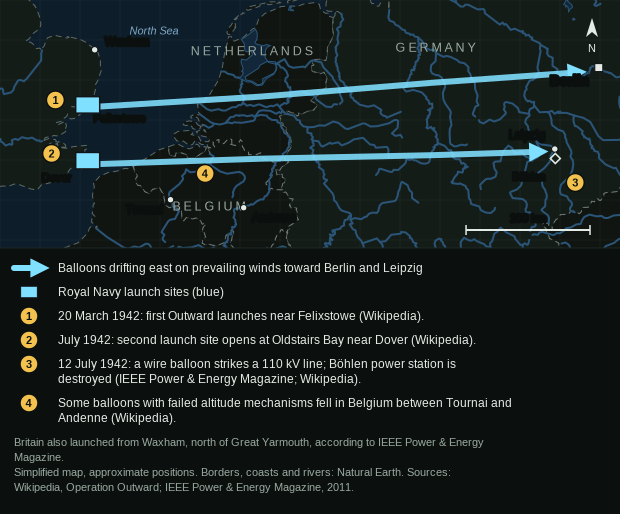
From 20 March 1942 to 4 September 1944, the Royal Navy released 99,142 hydrogen balloons from the English coast to drift east over Germany and German occupied Europe, in a British campaign Wikipedia calls Operation Outward. About half carried a trailing steel wire meant to short circuit high voltage power lines, and the rest carried incendiary devices meant to start fires in fields, forests and heathland. The balloons had no guidance and went wherever the wind took them.
What happened
Wikipedia records that a gale on the night of 17 and 18 September 1940 broke loose British barrage balloons and carried them across the North Sea, where they damaged power lines in Sweden and Denmark. Winston Churchill then ordered that drifting balloons be studied as a weapon. The Air Ministry reported against the idea, and the Admiralty, pushed by Captain Gerald Banister, Director of Boom Defence, took it up. The Chiefs of Staff approved in September 1941, and the first launches came on 20 March 1942 from near Felixstowe in Suffolk. A second site opened at Oldstairs Bay near Dover in July 1942.
The drones
The Outward balloon was a surplus latex weather balloon about 8 ft (2.4 m) across, filled with hydrogen, and cost £1 15s each according to Wikipedia. A slow burning fuse released the payload after the planned flight time. Wikipedia says the wire payload was about 700 ft (210 m) of hemp cord attached to 300 ft (91 m) of steel wire 1.8 mm thick. The incendiary payloads were called beer, jelly and socks: canisters of phosphorus grenades, cans of incendiary jelly, and canvas bags of wax soaked material. Raoul Drapeau, writing in IEEE Power & Energy Magazine, calls the balloons an indiscriminate, unguided weapon.
How they were used
Wikipedia states that winds above 16,000 ft (4,900 m) tend to blow from west to east, which made it hard for Germany to reply in kind. The launch crews were 80 Royal Marines, six Royal Navy and Royal Marine officers, and 147 Women's Royal Naval Service officers and ranks. By early August 1942 launches reached 1,000 balloons a day. From May 1944 the mass launches gave way to a trickle from three sites, and only 2% of those balloons carried wires. Wikipedia compares the campaign with Japan's Fu Go balloon campaign, saying the Outward balloons flew lower, at 16,000 ft (4,900 m) against 38,000 ft (12,000 m).
What effect they had
On 12 July 1942 a balloon launched the day before struck a 110 kV line near Leipzig. Drapeau writes that a phase to phase short made the breakers fail, a generator at Böhlen power station went out of synchronism, and the explosion and fire that followed destroyed the station and took 250 MW of capacity out of service. A British team put that loss at £1,000,000. A 1946 report put total damage at £1,500,000 and said the true figure was higher because records were incomplete. Drapeau reports that the Luftwaffe sent up as many as 250 fighters against balloons at once, and that German line clamps and more sensitive breakers did not solve the problem.
For the classroom
- Why did British planners count German fighters sent up against cheap balloons as part of the attack's value?
- The balloons had no guidance and went wherever the wind took them. What does that show about the limits of an unguided weapon?
- Wikipedia and Drapeau give different counts of wire balloons, 54,599 and 45,599. How would you check which is right?
Sources
- Wikipedia: Operation Outward
- Operation Outward, Britain's World War II offensive balloons, part 1 (IEEE Power & Energy Magazine, 2011)
- Operation Outward, Britain's World War II offensive balloons, part 2 (IEEE Power & Energy Magazine, 2011)
- Operation Outward, Britain's World War II offensive balloons, part 3 (IEEE Power & Energy Magazine, 2011)
Written 2026-10-04.