
Fu-Go balloon campaign
- When
- 3 November 1944 to April 1945
- Where
- Launched from Honshu against western North America
- Sides
- Japan vs United States and Canada
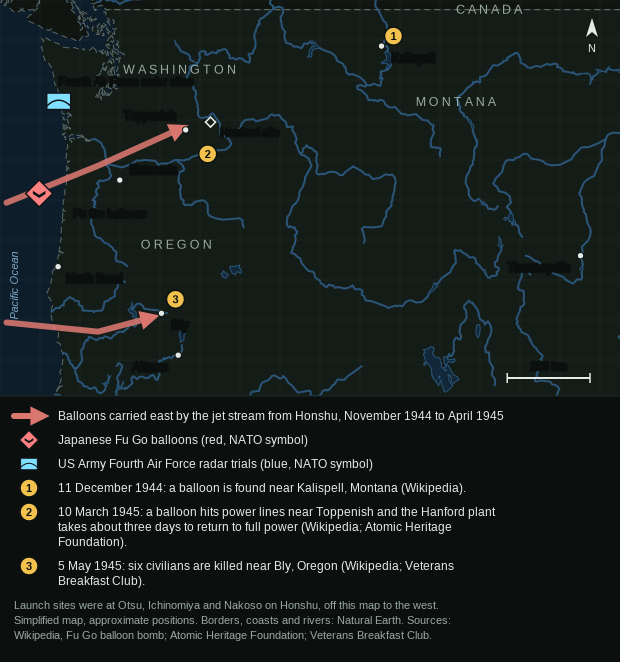
From 3 November 1944 to 20 April 1945, the Imperial Japanese Army launched about 9,300 hydrogen balloons from coastal Honshu to carry bombs across the Pacific to North America. Wikipedia describes the Fu Go as an incendiary balloon weapon deployed by Japan against the United States, and says about 300 balloons were found or observed in the United States, Canada and Mexico. One killed six civilians in Oregon on 5 May 1945.
What happened
Wikipedia records that the Imperial General Headquarters ordered work on a retaliatory weapon after the Doolittle Raid of April 1942, and that the Noborito Research Institute revived a balloon bomb project. The first balloons were launched on 3 November 1944. Balloons turned up near Thermopolis, Wyoming, on 6 December and near Kalispell, Montana, on 11 December. Veterans Breakfast Club writer Todd DePastino says the Japanese took the idea from British incendiary balloons used against Germany, as in Operation Outward. Wikipedia also lists Austrian balloon bombs at Venice in 1849 among earlier uses. By mid April 1945 paper and hydrogen were short, and the last balloon went up on 20 April.
The drones
Wikipedia gives the final A Type balloon as 33 feet (10 m) across, with 19,000 cubic feet (540 cubic metres) of gas and a lifting capacity of 300 pounds (140 kg). It was made from layers of washi paper glued by teenage girls. The usual load was four 11 pound (5.0 kg) thermite incendiaries and one Type 92 anti personnel bomb of 33 pounds (15 kg). A ballast wheel held 32 sandbags released by barometers to keep the balloon aloft. A Navy rubberized silk B Type burst in August 1944 tests. Three launch battalions ran the sites: 1,500 men at Otsu, 700 at Ichinomiya and 600 at Nakoso.
How they were used
Wikipedia says meteorologist Hidetoshi Arakawa estimated that a balloon holding 30,000 to 35,000 feet in winter winds of nearly 200 miles per hour (320 km/h) would reach North America in 30 to 100 hours. DePastino puts the crossing at three days or less. Wikipedia counts about 700 launches in November, 1,200 in December, 2,000 in January, 2,500 in February and March, and 400 in April. American fighters shot down only about 20, and radar trials in coastal Washington detected nothing. The Army's Firefly Project put 2,700 troops, including 200 paratroopers, on 36 firefighting missions in 1945.
What effect they had
On 5 May 1945 near Bly, Oregon, Elsie Mitchell, 26, and five children aged 11 to 14 died when they found a balloon in Fremont National Forest, according to Wikipedia. They were the only people killed by enemy action in the continental United States in the war. On 10 March 1945 a balloon hit power lines near Toppenish, Washington, and the Atomic Heritage Foundation quotes Colonel Franklin Matthias saying the Hanford plant took about three days to return to full power. Wikipedia attributes only one or two small grass fires to the campaign. The Office of Censorship asked editors on 4 January 1945 to give the balloons no publicity, and the Imperial Army learned of just one find, from a Chinese newspaper. Wikipedia says Japan destroyed all records of the program on 15 August 1945, so one interview with Lieutenant Colonel Terato Kunitake supplied most of what US investigators learned of its aims.
For the classroom
- Why did Japan launch the balloons only between November and April, and what did that timing mean for starting fires?
- How did the Office of Censorship's silence shape both Japan's decision to stop and the Bly deaths?
- Why does most knowledge of Japanese aims rest on one postwar interview?
Sources
- Wikipedia: Fu Go balloon bomb
- Japanese Balloon Bombs Fu Go (Atomic Heritage Foundation, 2016)
- Veterans Breakfast Club: The Japanese Fu-Go (Fire Balloons) Attacks of 1944-1945
Written 2026-10-04.