
Siege of Venice balloon bombs
- When
- May to August 1849 (balloon attack 15 July)
- Where
- Venice
- Sides
- Austrian Empire vs Republic of San Marco
In the summer of 1849, Austrian forces besieging Venice sent unmanned paper hot air balloons carrying time fused bombs toward the city, which Wikipedia describes as the first aggressive use of balloons in warfare. Wikipedia names the sides as the Austrian Empire and the Republic of San Marco. The artillery officer Franz von Uchatius designed the balloons. Most missed their target, and the republic's leaders agreed terms of surrender on 22 August 1849.
What happened
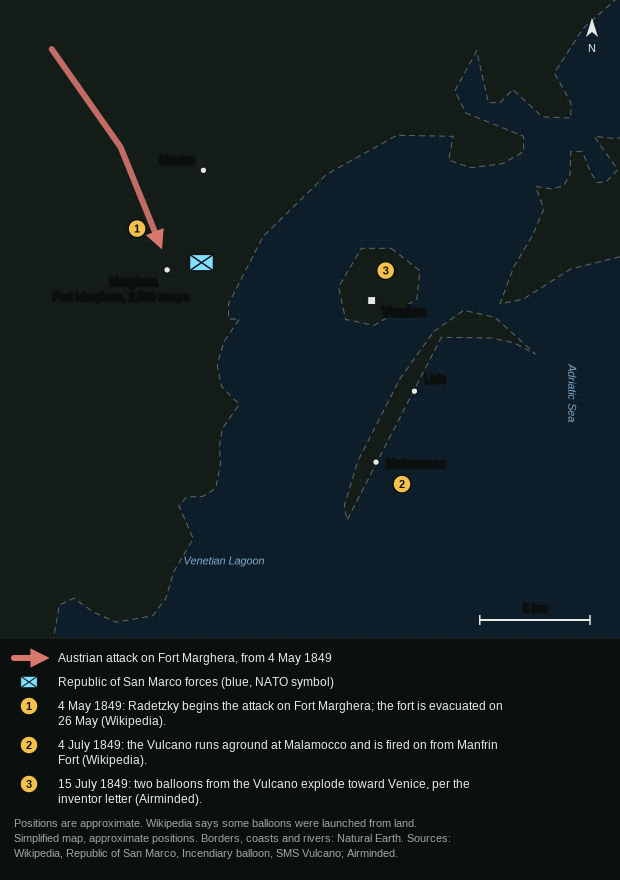
Wikipedia records that the Republic of San Marco lasted 17 months in 1848 and 1849, led by Daniele Manin after a revolt against Austrian rule. After the Piedmontese defeat at Novara on 23 March 1849, Venice voted to fight on. On 4 May 1849 Field Marshal Radetzky began the attack on Fort Marghera, held by 2,500 troops under Girolamo Ulloa. Wikipedia says 60,000 projectiles were fired toward Venice in the next three weeks. Ulloa ordered the fort evacuated on 26 May. By August famine and cholera were spreading in the city. Terms were agreed on 22 August, and Radetzky entered Venice on 27 August.
The drones
Wikipedia's article on incendiary balloons says the Austrians tried to deploy about 200 paper hot air balloons, each with a bomb of 24 to 30 pounds (11 to 14 kg) and a time fuse. Russell Naughton of Monash University, quoted by History.com, gave 33 pounds of explosive per balloon. The Airminded blog notes that the bombs were filled with shrapnel and that Lee Kennett found 200 to be the largest number of balloons claimed, though a Morning Chronicle report suggests only two were launched. Wikipedia says smaller pilot balloons were used to set the fuse times. History.com says Uchatius planned fuses timed to half an hour.
How they were used
Wikipedia says most balloons were launched from land and some from the paddle steamer SMS Vulcano, which served as a balloon carrier. Airminded quotes a Morning Chronicle report of 29 August 1849 on a letter from Uchatius. It says the wind blew from the sea nine times out of ten, so the balloons had to be inflated on a ship. On 15 July, the letter says, two balloons armed with shrapnel rose from the deck of the Vulcano, travelled 3,500 fathoms toward Venice and exploded after 23 minutes, as calculated. Further trials stopped when the ship went into dock for repairs. Airminded adds that Kennett places the first armed test on 12 July. History.com dates the raid to 22 August, the day terms were agreed.
What effect they had
Wikipedia states that at least one bomb fell in the city, but a change of wind after launch sent most balloons off target, and some drifted back over Austrian lines and over the Vulcano. History.com says one landed in Piazza San Marco and that the balloons did little damage. The Uchatius letter says the captain of the English brig Frolic and others in Venice testified to terror among the inhabitants. Wikipedia assesses the overall effect as probably low compared with traditional artillery. Airminded notes the siege lasted about five more weeks and that Lawrence Sondhaus put Austrian shelling at about a thousand shells a day. Airminded found almost no notice of the raids in the British press at the time. In the next century, History.com says, Japan sent nearly 10,000 bomb carrying balloons toward North America in the Fu Go balloon campaign.
For the classroom
- Why did the Austrians inflate balloons on a ship rather than on land, according to Uchatius?
- How did a timer and a change of wind limit what the balloons could hit?
- Why might historians disagree on whether the balloons caused fear or damage in Venice?
Sources
- Wikipedia: Republic of San Marco
- Wikipedia: Incendiary balloon
- The first air bomb: Venice, 15 July 1849 (Airminded)
- Austria attacks Venice with balloon bombs (HISTORY)
- Wikipedia: SMS Vulcano
- Wikipedia: Venetian Lagoon
- Wikipedia: Malamocco
- Wikipedia: Marghera
- Wikipedia: Mestre
- Wikipedia: Chioggia
- Wikipedia: Venice
Written 2026-10-04.