
Operation Rough Rider
- When
- 15 March to 6 May 2025
- Where
- Yemen and the Red Sea
- Sides
- United States vs Houthis
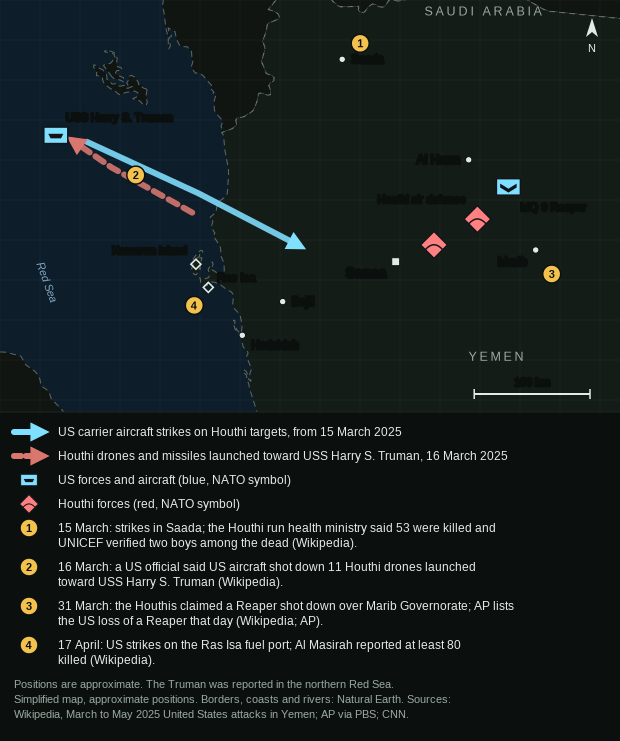
From 15 March to 6 May 2025, the United States bombed Houthi targets across Yemen in a campaign codenamed Operation Rough Rider, and drones mattered on both sides. Wikipedia names the sides as the United States, joined by the United Kingdom from 30 April, and the Houthis. American MQ 9 Reaper drones flew attack and surveillance missions over Yemen, and AP reported that Houthi air defences shot down seven of them. The Houthis, in turn, launched one way attack drones at American warships.
What happened
Wikipedia records that the Houthis resumed attacks on shipping in March 2025 after the January Gaza ceasefire, and the United States responded. The strikes began on 15 March against radar systems, air defences and missile and drone launch sites. The campaign grew out of the Red Sea crisis and the wider Gaza war. Central Command spokesman Dave Eastburn said on 24 April that more than 800 targets had been struck. Oman brokered a ceasefire, and Trump declared the strikes over on 6 May. The Houthis said the truce did not cover Israel, which they had already struck in the July 2024 Houthi Israel attacks with a drone that killed one person in Tel Aviv.
The drones
The American drone was the General Atomics MQ 9 Reaper. AP reported that it costs about 30 million US dollars and generally flies above 40,000 feet, or 12,100 m. Wikipedia lists the USAF version at 11 m long with a 20 m wingspan, an endurance of 27 hours and a ceiling of 50,000 feet. Navy aircraft flew from the USS Harry S. Truman, and AP reported that the USS Carl Vinson was in the Gulf of Aden by 25 April. The Houthi side used air defences against the Reapers and one way attack drones against ships. CNN, citing US officials, said the Houthis launched 77 one way attack drones, 30 cruise missiles, 24 medium range ballistic missiles and 23 surface to air missiles in six weeks.
How they were used
CNN reported that the US hoped to win air superiority within 30 days and then use drones for surveillance of senior Houthi leaders. The MQ 9s were the aircraft best suited to that work, officials told CNN, and the United States has no troops in Yemen, so it relied on overhead surveillance for damage assessment. AP's defence officials listed Reaper losses on 31 March and on 3, 9, 13, 18, 19 and 22 April, with three in the last week, and said hostile fire was the likely cause. The Houthis claimed one over Marib Governorate on 31 March. On 16 March a US official said American aircraft shot down 11 Houthi drones heading for the Truman.
What effect they had
AP put the seven Reapers at more than 200 million US dollars. A defence official told CNN the losses made it harder to judge damage to Houthi stockpiles. Eastburn said Houthi one way drone attacks had fallen 65 percent and ballistic missile launches 87 percent. Wikipedia reports the New York Times conclusion that the United States had not established air superiority. US strikes also killed civilians. UNICEF verified two boys among the dead in Saada on 15 March. Airwars estimated 224 civilians killed, and a Pentagon assessment cited by The Hill recorded 153.
For the classroom
- Why did the loss of Reapers slow the plan to track senior Houthi leaders?
- Why would cheap Houthi one way drones aimed at a carrier force the US Navy to spend expensive interceptors?
- What does a cost of 30 million US dollars per Reaper mean for a campaign lasting seven weeks?
Sources
- Wikipedia: March–May 2025 United States attacks in Yemen
- Houthis have shot down 7 Reaper drones (AP via PBS, 2025)
- Houthis' successful targeting of US drones (CNN, 2025)
- Iran Update, April 25, 2025 (ISW)
- Wikipedia: General Atomics MQ 9 Reaper
Written 2026-10-04.