
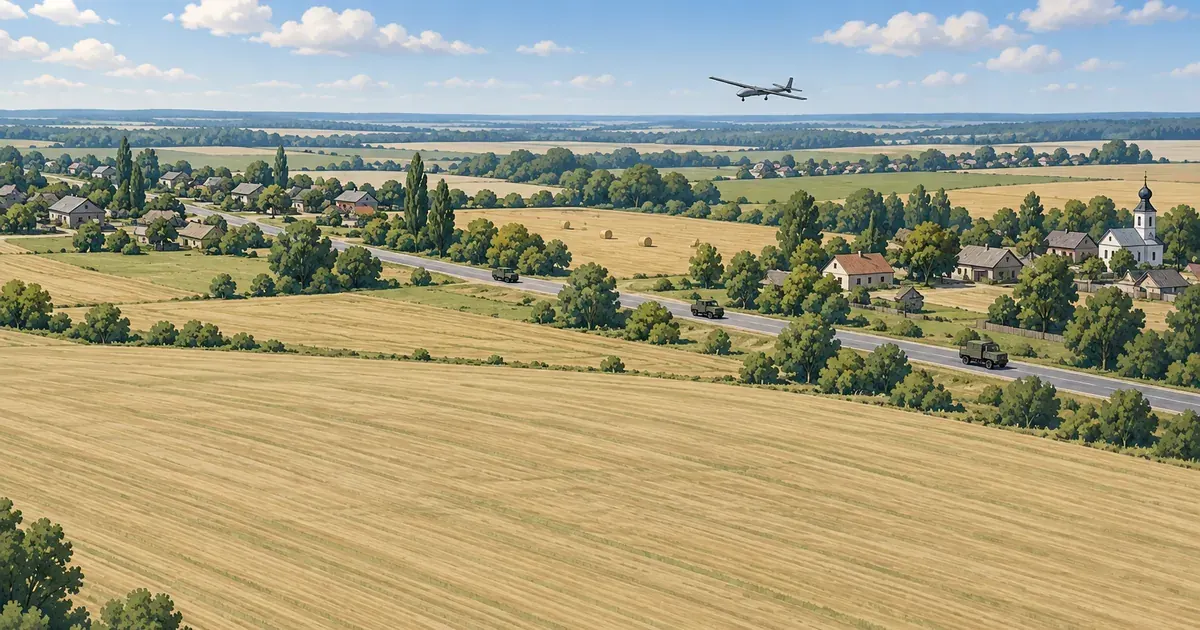
The Sudzha Road
Sudzha, Kursk Oblast, Russia · August 2024 to March 2025
Read the battle page: Kursk campaign
Learning objectives
- Compare the Kyiv Independent’s attributed account of logistics under drone pressure with loss of supply units in the model; distinguish a reported road-access problem from the simulation’s supply-cutoff rule.
- Compare jamming and interceptor drones as defences against enemy drones, and identify why jamming fails against fibre optic drones.
- Assess the model’s cold-weather reductions in small-drone flight time and increase in thermal visibility, and explain why these fixed parameters are teaching assumptions rather than measured effects for every historical flight.
Run time and a good result
Default run clock: 2 minutes 40 seconds at 1×, excluding pauses, briefing and discussion. Time controls change elapsed play time.
Objective: Keep supplies moving up the road from Yunakivka and hold Sudzha until time runs out.
The Sudzha Road: Keep supplies moving up the road from Yunakivka and hold Sudzha until time runs out. Prevent an unopposed enemy occupation of the marked zone lasting 8 continuous simulation seconds; retain a fighting force until the episode ends. The authored limit is 160 simulation seconds across 1 stage. Compare objective progress, time, losses, drone expenditure and recorded civilian harm with a second run. A strong classroom result also explains the source evidence and reconstruction estimates; it does not verify a historical casualty count.
Timings
For 60 minutes, brief for 10, run once in cold with three pauses for 25 and review for 25; for 90 minutes, disable your side’s drones in a comparison run and compare supply cutoff; for 180 minutes, compare fog and strict rules of engagement, reporting time held, supply-unit losses and civilian harm separately from equipment costs.
| Session | Plan |
|---|---|
| 45 minutes | Brief: 10 min; Run: 15 min; Collect: 5 min; Review: 15 min |
| 60 minutes | Before questions: 5 min; Brief: 10 min; Run: 20 min; Collect: 5 min; Debrief and after questions: 15 min; Discussion: 5 min |
| 90 minutes | Before questions: 5 min; Brief: 10 min; Run 1: with drones: 20 min; Run 2: without drones: 15 min; Collect: 5 min; Compare and discuss: 25 min; After questions: 10 min |
| 180 minutes | Before questions: 10 min; Brief and staff roles: 15 min; Run 1: with drones: 25 min; Run 2: without drones: 20 min; Break: 10 min; Run 3: syndicates: 30 min; Collect: 10 min; Seminar replay and debrief: 40 min; After questions: 10 min; Close: 10 min |
Staff roles
- commander
- Choose the posture in the briefing and the rules of engagement and target priority during the run, and report whether Sudzha can be held until time runs out if supplies are cut.
- intelligence
- Track enemy recon flights and fibre optic attacks along the road, and report which supply units and positions the enemy has probably found.
- fires
- Report what your two batteries engage, how many shells remain, any Lancet attack on them and any strike near civilians in Sudzha.
- droneOps
- Split the interceptors, quadcopters, FPVs, bomber drones and the Shark between protecting the road and hitting the attackers, and report how much the cold is cutting flight time.
Opposing staff objective
Retake Sudzha before time runs out, attacking from Malaya Loknya in the north, Martynovka and the Kursk road in the east and the Psel valley in the south east, while your drones cut the road from Yunakivka.
Decision points
- Before the first launch: your three supply units sit along the highway from Yunakivka into Sudzha, so which drones will you spend on the enemy recon drones that find targets on that road, and which on the attacking infantry?
- When the first fibre optic drones start hitting vehicles on the road: your jamming cannot stop them, so do you change target priority, send interceptors after the enemy recon drones, or accept the losses and keep striking the attackers?
- When enemy infantry reach the edge of Sudzha: what do your rules of engagement allow you to strike among the civilians who live there, and how will you hold the town under them?
Before and after questions
What supply difficulty did the medic interviewed by Farrell report from the Sudzha fighting?
- The main problem was maintaining shelter rather than supplies
- Farrell's medic described deteriorating logistics along supply routes monitored by fibre-optic drones
- The main problem was limited communication between forward positions
- The main problem was seasonal river conditions affecting transport
Answer B: Farrell's medic interview describes disrupted logistics and routes monitored by fibre-optic drones. This is an attributed experience, not proof of one sole road or a complete causal reconstruction.
What distinguishes fibre-optic control from the radio link of an ordinary FPV drone?
- A physical cable carries the control connection
- An onboard relay repeats ordinary radio control signals
- A preset route replaces continuous operator steering inputs
- An onboard camera supplies control without an operator
Answer A: Farrell describes a physical cable carrying control and video. Radio-link jamming does not sever it; cable breakage and other failure modes still remain.
What displacement figure did the March 2025 investigation published in Meduza attribute to official Russian data?
- Large numbers had reportedly returned to occupied Sudzha
- Evacuations remained limited to a few villages
- Residents were being relocated to Sumy Oblast
- At least 112,000 civilians had reportedly been displaced
Answer D: The translated 7x7 investigation attributes at least 112,000 displaced civilians to official Russian data. This verifies that reported attribution, without confirming the earlier October/ombudsman formulation.
According to Farrell's May 2025 reporting, which side introduced fibre-optic FPVs first in this fighting?
- Ukraine first, with Russia adopting them later
- Russia first, with Ukraine expanding use later
- Russia and Ukraine expanded simultaneously using similar initial stocks
- Ukraine introduced them while Russia retained radio-controlled designs only
Answer B: Farrell reports Russian initial deployment in Kursk and subsequent Ukrainian expansion. This remains the article's account; it is not an independently counted fleet comparison.
How did the fighting for Sudzha end in March 2025?
- A negotiated local agreement preserved Ukrainian control
- A reported Russian capture lacked subsequent Ukrainian confirmation
- A Ukrainian withdrawal was subsequently officially confirmed
- A Ukrainian redeployment preserved control of central Sudzha
Answer C: The Kyiv Independent reports Russia's13 March capture claim and says Ukraine's16 March General Staff maps showed withdrawal from Sudzha. Its confirmation was map-based, rather than a separate withdrawal announcement.
Discussion
- Were all three modeled supply units destroyed, triggering supply cutoff? If so, when did it occur, and what changed in artillery resupply, vehicle speed and drone turnaround time? Explain how this rule differs from actual road access.
- Compare runs with your side’s drones enabled and disabled, leaving enemy drones unchanged. Compare supply-unit survival, time held and losses, and identify which real road-access problems the model does not represent.
- Civilians live in Sudzha, the town you are holding. How did your rules of engagement shape its defence once enemy infantry reached it, and what civilian harm does the after action review record?
- Farrell’s May 2025 reporting describes earlier Russian deployment at scale and Ukrainian teams adopting fibre optic drones. Which testimony supports that account, which limits remain, and how does the modeled inventory simplify that dated comparison?
Debrief rubric
- Strong
- Meets the objective or explains why it was not met; uses the published sources and run evidence, separates known facts from assumptions, compares both sides’ losses and cost exchange, and evaluates precautions against civilian harm.
- Adequate
- Describes the objective and main decisions, identifies at least one source and model limitation, reports losses and harm, and gives a reasoned change for a second run.
- Weak
- Reports only victory or points, treats teaching settings as real performance, gives unsupported historical claims, or omits uncertainty and civilian harm.
Published readings
- Kyiv Independent: As Russia’s fiber optic drones flood the battlefield, Ukraine is racing to catch up
- ISW (via Critical Threats): Russian Offensive Campaign Assessment, 12 March 2025
- Kyiv Independent: Ukraine confirms withdrawal from Sudzha in Russia’s Kursk Oblast
Complete source list
- Kyiv Independent: As Russia’s fiber optic drones flood the battlefield, Ukraine is racing to catch up
- ISW (via Critical Threats): Russian Offensive Campaign Assessment, 12 March 2025
- Kyiv Independent: Ukraine confirms withdrawal from Sudzha in Russia’s Kursk Oblast
- Al Jazeera: Russia says it has fully retaken Kursk, but Ukraine says fighting continues
- Wikipedia: Kursk campaign
- Wikipedia: Sudzha
- Wikipedia: Yunakivka