
Deep strike campaign
- When
- 2024 to present
- Where
- Russia, 500 to 2,500 km from Ukraine
- Sides
- Ukraine vs Russia
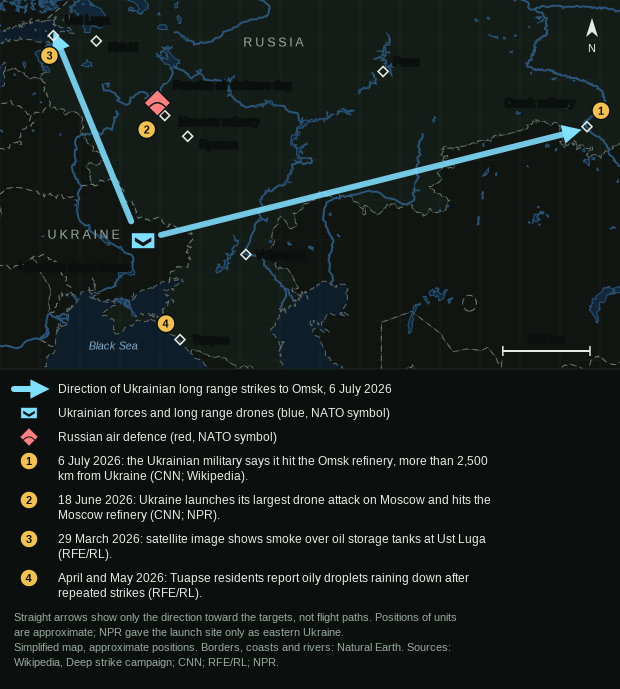
Since early 2024, the Defence Forces of Ukraine have used long range one way attack drones against oil refineries, ports, airfields and arms plants inside Russia, a campaign Wikipedia calls the deep strike campaign and lists as ongoing. Wikipedia names the sides as Ukraine and the Russian Federation. By June 2026 Ukraine was launching an average of 200 to 300 drones a night, and on 6 July 2026 the Ukrainian military said it struck the Omsk refinery, more than 2,500 kilometres from the Ukrainian border.
What happened
Wikipedia records that the campaign began in early 2024 with a few dozen drones a month. A CNN analysis of 25 June 2026, summarised by Wikipedia, counted 305 Ukrainian strikes on Russian oil facilities since February 2022, only 3 of them in the first year of the war and 92 in the third. The Economist reported that Ukraine carried out 685 deep strikes in 2025. The campaign runs alongside other Ukrainian operations inside Russia, such as Operation Spiderweb and the Kursk campaign.
The drones
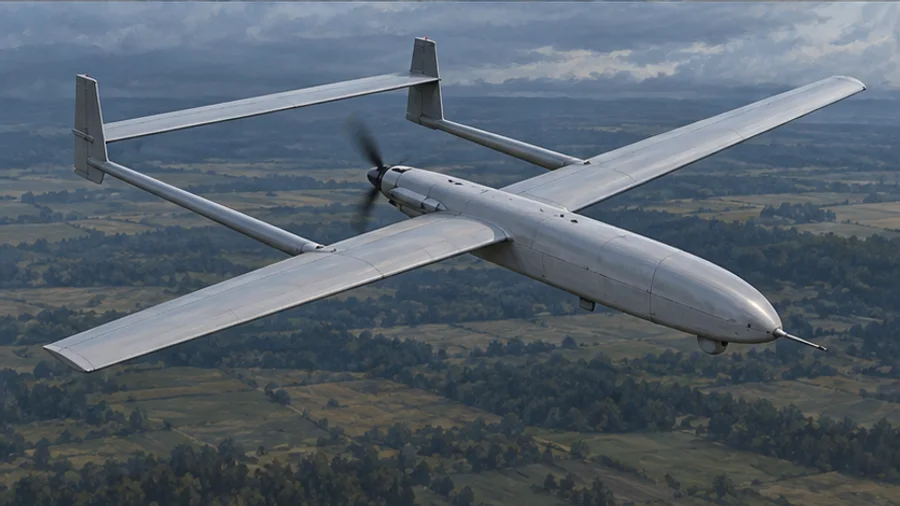
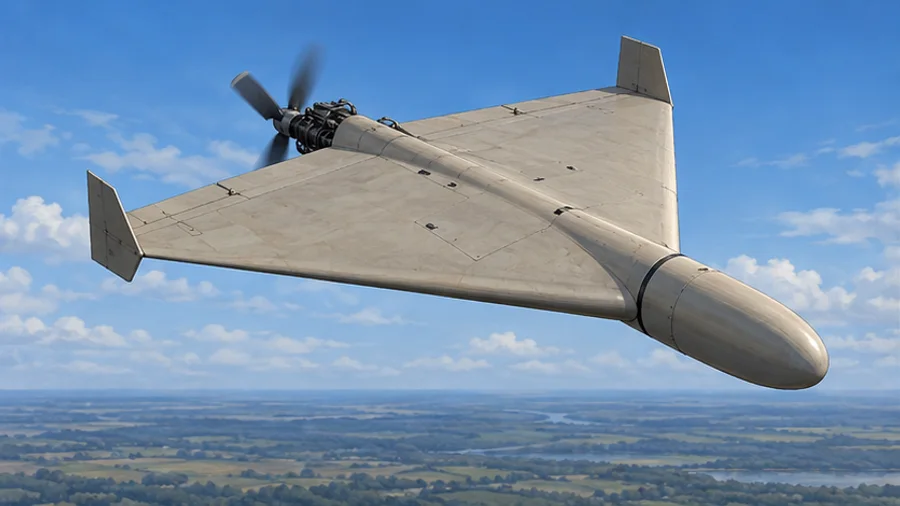
Wikipedia names the AN 196 Liutyi, the Fire Point FP 1, the UJ 25 Skyline, the UJ 26 Bober and the Peklo as the main long range drones. It lists the Liutyi at 250 to 300 kg with a 50 to 75 kg warhead and a range of 1,000 to 2,000 km, and calls it an analogue of the Russian Shahed 136. For the FP 1 it lists a warhead of 60 to 120 kg, a range up to 1,600 km and a unit cost of US$55,000 to $75,000, a figure it attributes to the Fire Point chief executive. Wikipedia gives the Bober a reported range of 600 to 1,000 km.
How they were used
NPR visited the First Separate Center of Unmanned Systems as soldiers launched Fire Point drones from a farm field in eastern Ukraine. A launcher with the callsign Push described sending drones almost every night. RFE/RL cited the French researcher Clement Molin, who counted about 1,000 Ukrainian drones launched into Russia in August 2024, 3,000 in July 2025 and 7,000 in March 2026. A soldier of the 59th Assault Brigade, Oleksandr Karpyuk, told RFE/RL that drones arrive first to use up Russian air defences and missiles follow. Wikipedia lists strikes on the Baltic ports of Primorsk, 1,087 km away, on 22, 23 and 25 March 2026, and Ust Luga, 875 km away, on five dates from 22 to 31 March. On 18 June 2026 Ukraine launched its largest drone attack on Moscow and hit the Moscow refinery, CNN and NPR reported.
What effect they had
On 4 July 2026 the Ukrainian General Staff estimated that 42.74 percent of Russia's oil refining capacity was disabled, while the International Energy Agency said more than 20 percent was offline, Wikipedia records. CNN found that almost all of Russia's 83 regions had gasoline shortages or supply disruption by 6 July, and that Crimea banned fuel sales to ordinary people on 21 June. Putin called the shortages "not critical" and said the most urgent task was to raise air defence production. Fabian Hoffmann of the University of Oslo wrote that the strike campaign alone does not win the war, though its constraints weigh on Russia's budget and planning.
For the classroom
- Why did Ukraine send drones ahead of missiles against Russian air defences, according to Karpyuk?
- The Ukrainian General Staff claimed 42.74 percent of refining capacity was disabled and the IEA said more than 20 percent; what could explain the gap?
- Which targets become reachable when a drone's range grows from 200 to 2,500 kilometres?
Sources
- Wikipedia: Deep strike campaign
- Almost every Russian region hit by fuel crisis, as Ukraine escalates drone attacks (CNN, 2026)
- Drone Strikes, Deep Strikes: How Ukraine's Long Range Air Attacks Are Hurting Russia (RFE/RL, 2026)
- Inside a secretive Ukrainian team launching deep drone strikes at Russia (NPR, 2026)
- Wikipedia: Liutyi
- Wikipedia: Fire Point FP 1
- Wikipedia: Bober (drone)
Written 2026-10-04.