
Operation Spiderweb
- When
- 1 June 2025
- Where
- Five air bases across Russia
- Sides
- Ukraine (SBU) vs Russia
- Drones
- FPV attack drone
On 1 June 2025, the Security Service of Ukraine (SBU) used small drones hidden in trucks inside Russia to attack parked aircraft of the Russian Air Force's Long Range Aviation at five air bases, during the Russo Ukrainian War. Wikipedia calls it Operation Spiderweb and describes it as the largest drone attack on Russian air bases up to that point. Ukrainian officials said 117 drones were used. The SBU claimed 41 aircraft hit, while two US officials told Reuters that about 20 were hit and 10 destroyed.
What happened
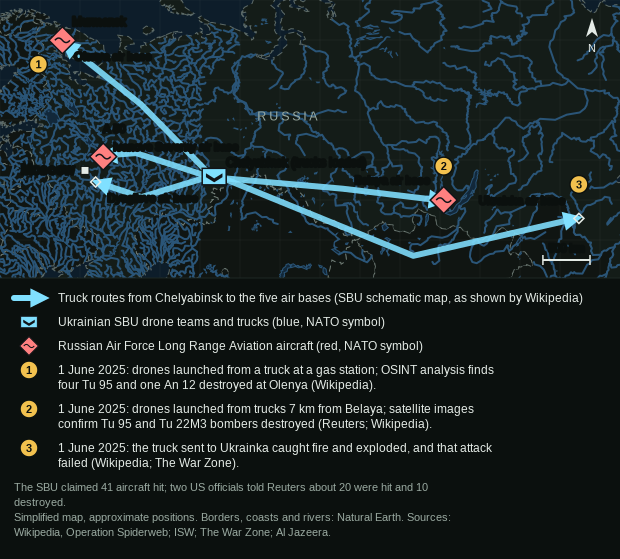
Wikipedia lists the targets as Olenya in Murmansk Oblast, Belaya in Irkutsk Oblast, Dyagilevo in Ryazan Oblast, Ivanovo Severny in Ivanovo Oblast and Ukrainka in Amur Oblast. President Volodymyr Zelenskyy said planning took 18 months and 9 days, and Wikipedia says the SBU head, Vasyl Malyuk, carried it out. Al Jazeera reported that Belaya lies about 4,300 km from the Ukrainian border. Russia's Ministry of Defence said attacks took place in five regions, that several aircraft caught fire in Murmansk and Irkutsk, and that the rest were repelled. Wikipedia records that the Ukrainka attack failed when the truck carrying the drones caught fire and exploded. ISW noted the first drone strike of the war on a target in Siberia.
The drones
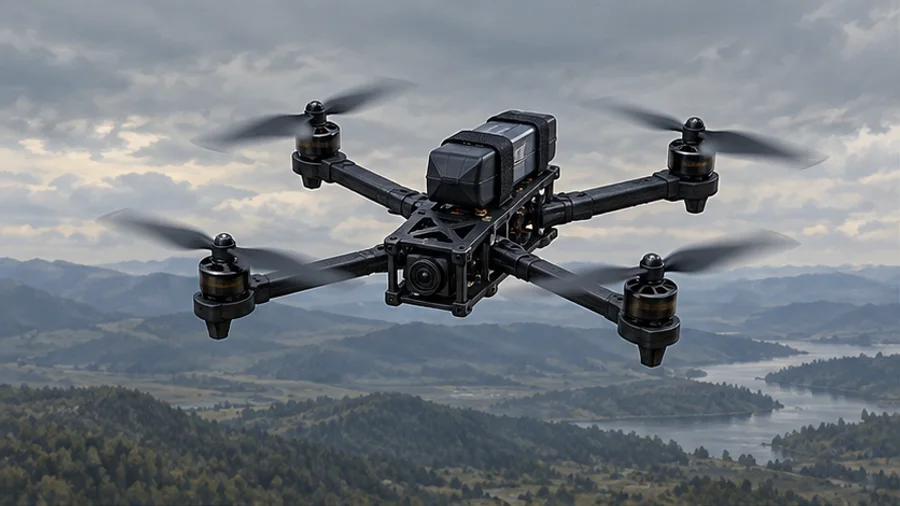
Wikipedia states the drones were Ukrainian made Osa ("Wasp") quadcopters, each with a payload of just over 3.2 kg. About 36 were placed in compartments under the roof of each of several wooden containers built to look like ordinary mobile cabins, carried on flatbed trucks. The SBU published photos of the drones under the roofs in a warehouse later identified as being in Chelyabinsk. Wikipedia reports that the drones were flown remotely with the open source ArduPilot software and that Zelenskyy said each had its own pilot. The Wall Street Journal reported that more than 100 quadcopters were smuggled into Russia in parts and assembled there.
How they were used
Wikipedia records that Russian drivers who did not know the cargo were hired to take each truck to a destination, and each received a phone call giving the place to stop. Then the roof was raised by remote control and the drones took off. Reuters found where one truck stopped, on the P 255 highway 7 km from Belaya. ISW assessed that launching FPV drones close to the bases probably helped them avoid Russian electronic warfare and left air defenders little time to react. Wikipedia reports that pilots aimed at weak points such as wing fuel tanks, and onlookers attacked the drones from one truck with stones.
What effect they had
The War Zone quoted Andriy Kovalenko of Ukraine's National Security and Defense Council saying at least 13 Russian aircraft were destroyed. An open source tally cited by Wikipedia gives four Tu 95 at Olenya, three or four Tu 22M3 and three Tu 95 at Belaya, one An 12 and two A 50 aircraft targeted at Ivanovo Severny. The Financial Times estimated the damage at about 20% of Russia's operational long range aviation fleet. The Tu 95 and Tu 22M3 fire cruise missiles at Ukraine, part of the Russian strikes against Ukrainian infrastructure, and the operation sits beside Ukraine's other attacks on Russia in the Deep strike campaign. Four truck drivers were charged with terrorism, and Wikipedia records that a Moscow court released them in September 2026.
For the classroom
- Why did launching drones from trucks near the bases matter more than their range or payload?
- Why did hiring drivers who did not know the cargo help keep the operation secret?
- What would an air base need to defend against drones that start inside the country?
Sources
- Wikipedia: Operation Spiderweb
- Russian Offensive Campaign Assessment, June 1, 2025 (ISW)
- What Ukraine's Unprecedented Drone Attack Means For Russia's Bomber Force (The War Zone, 2025)
- Ukrainian drones target Russian airbases in unprecedented operation (Al Jazeera, 2025)
Written 2026-10-04.