
Russian strikes against Ukrainian infrastructure
- When
- From September 2022
- Where
- Ukraine nationwide
- Sides
- Russia vs Ukraine
- Drones
- Shahed-136 / Geran-2, Gerbera
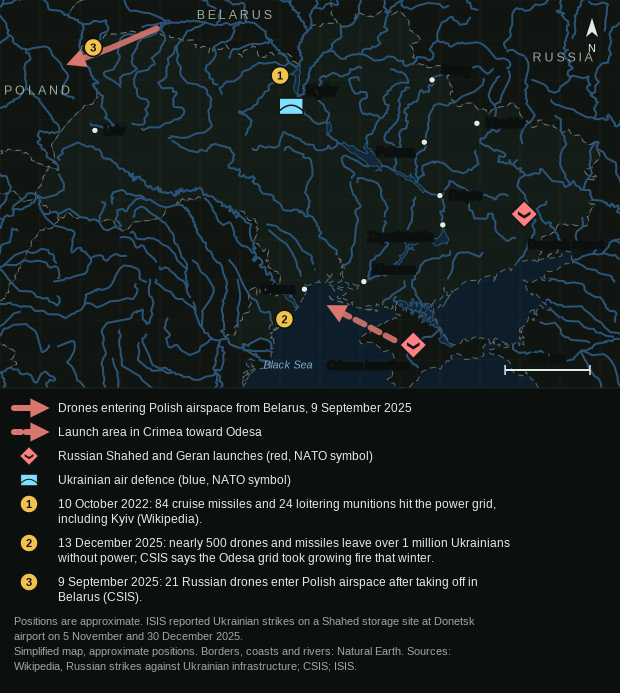
From September 2022, the Russian Armed Forces have launched waves of missile and drone strikes against energy and other infrastructure across Ukraine, a campaign Wikipedia describes as part of the Russian invasion of Ukraine. Wikipedia lists Shahed 136 drones, known in Russian service as Geran 2, among the weapons, alongside Kalibr and Kh 101 cruise missiles and Iskander ballistic missiles. CSIS wrote in July 2026 that drone launches grew from single digits in the first month to thousands each month.
What happened
Wikipedia records that on 10 October 2022 Russia attacked the power grid across Ukraine, including Kyiv, with 84 cruise missiles and 24 loitering munitions. The Financial Times reported that President Putin linked the strikes to the explosion on the Crimean Bridge. By 19 November, President Zelenskyy said, nearly half the power grid was out and 10 million Ukrainians had no electricity. The Kyiv Independent reported that by mid December Russia had fired more than 1,000 missiles and drones at the grid. The UN counted 77 civilians killed and 272 injured by 25 November 2022. Amnesty International said the attacks on energy infrastructure amounted to war crimes.
Scenario: Defend the Grid: Trypilska (Night of 10 to 11 April 2024)
The drones
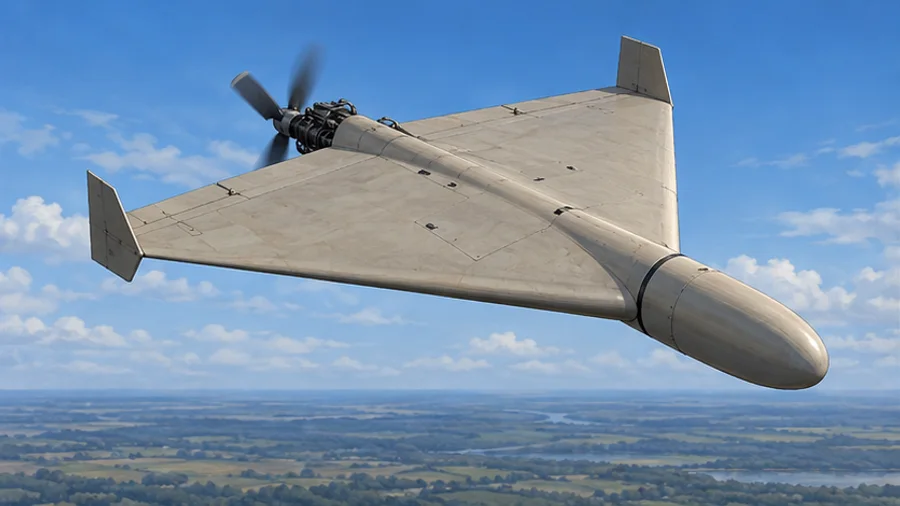
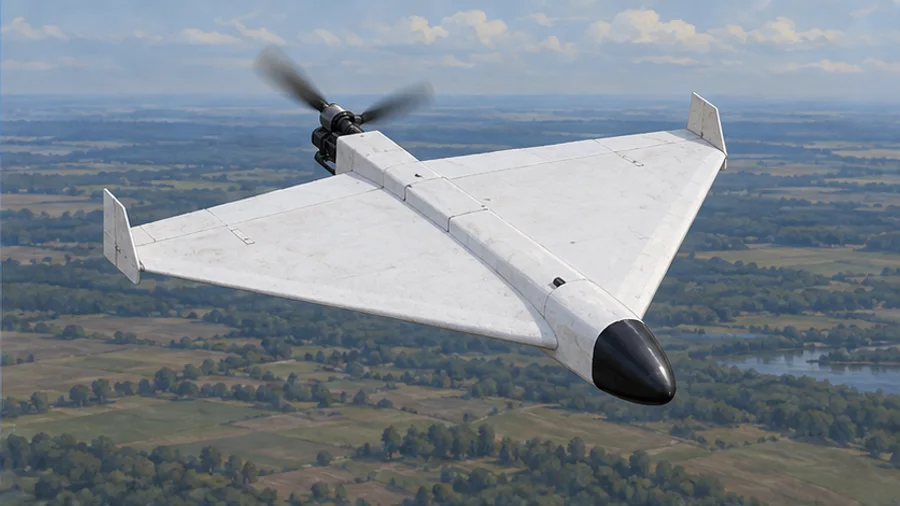
The Shahed 136 is a delta wing, one way attack drone with a piston engine. Wikipedia lists it at 3.5 m long, with a 2.5 m wingspan, a mass near 200 kg, a speed near 185 km/h and a warhead estimated at 30 to 50 kg. Igor Anokhin of the Institute for Science and International Security wrote that the Geran 2 is manufactured at Alabuga. Wikipedia reports a Geran 2 with a 90 kg warhead from May 2024, with a range of about 650 km, widely used against electricity infrastructure by May 2025. Anokhin counted decoys such as Gerbera among launches and noted jet powered Geran 3 drones, flown in the later Jet powered Geran raids.
How they were used
CSIS found that Russia launched roughly 510 missiles and drones in October 2022, about 250 of them Shaheds. The largest nightly salvo of 2024 was 193 drones; it reached 267 on 23 February 2025 and often exceeded 300 from May 2025. Anokhin reported 823 aircraft, including 810 Shahed type drones, on 7 September 2025, and wrote that mass raids come with missiles and are meant to exhaust air defences. CSIS said Belarusian airspace serves as a routing corridor, and that 21 drones entered Polish airspace from Belarus on 9 September 2025, in the 2025 Russian drone incursion into Poland.
What effect they had
Wikipedia cites the International Energy Agency for the finding that by mid 2024 Ukraine had a third of its prewar generating capacity. CSIS reported that on 13 December 2025 nearly 500 drones and various missiles left over 1 million Ukrainians without power, and counted about 55,000 drone launches in 2025 against just under 2,000 missiles. Anokhin put hits at 2 to 3 percent of launches in early 2025 and 11.5 to 18.7 percent from April, and noted reports of Ukrainian Sting interceptor drones downing jet powered Gerans, part of the fight over Shahed mass raids and interceptor drones. The UK Defence Ministry said the strikes aimed to demoralise the population; Wikipedia says that aim is widely judged to have failed.
For the classroom
- Why would Russia launch decoys such as Gerbera together with armed Shaheds and missiles?
- Anokhin counted hits at 2 to 3 percent in early 2025 and above 11 percent from April; what could explain that rise?
- Why did CSIS describe Shahed launches as a way to make defence more expensive?
Sources
- Wikipedia: Russian strikes against Ukrainian infrastructure
- Wikipedia: HESA Shahed 136
- The Geography of Coercion: Russian Missile and Drone Campaigns in Ukraine (CSIS, 2026)
- A Comprehensive Analytical Review of Russian Shahed type UAVs Deployment against Ukraine in 2025 (Institute for Science and International Security, 2026)
Written 2026-10-04.