
War of Attrition
- When
- 1969 to 1970
- Where
- Suez Canal and Jordan Valley fronts
- Sides
- Israel vs Egypt and Jordan
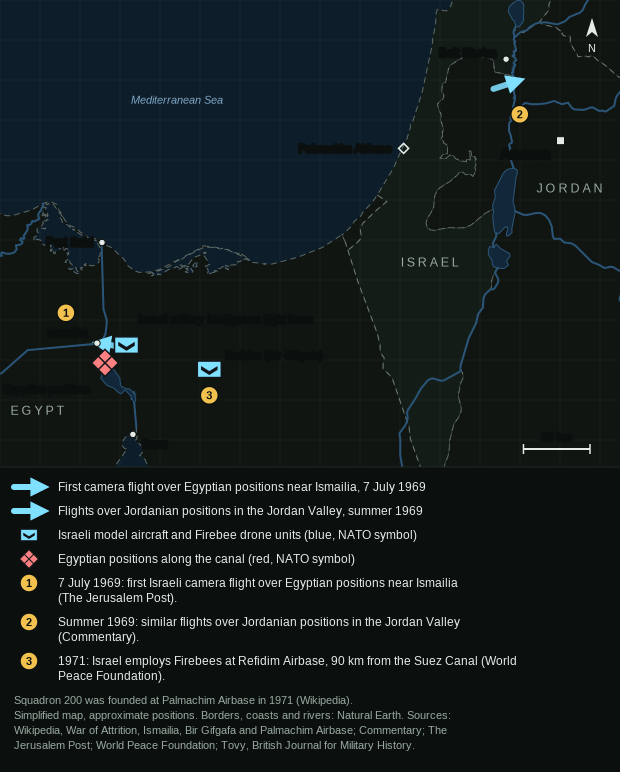
During the War of Attrition, which Wikipedia dates from 1 July 1967 to 7 August 1970 and describes as fighting between Israel and Egypt, Jordan, the PLO and their allies, Israeli military intelligence flew remote controlled model aircraft carrying cameras over Egyptian and Jordanian positions. Yaakov Katz of the Jerusalem Post gives 7 July 1969 as the date of the first flight, near Ismailia on the Suez Canal. Tal Tovy, writing in the British Journal for Military History, says these 1969 experiments led to Israel's first drone unit, Squadron 200.
What happened
Wikipedia records that Israel held the Sinai up to the east bank of the Suez Canal after the 1967 Six Day War, and that Egyptian President Gamal Abdel Nasser proclaimed the official launch of the War of Attrition on 8 March 1969, with shelling along the canal, air battles and commando raids. Katz wrote in Commentary that, because of Egyptian missiles, Israeli reconnaissance aircraft had to fly so high that their pictures had little value, and that Egyptian sand barriers 30 feet high hid the far bank. Tovy says that late in the war Egyptian air defences shot down several Israeli fighter jets.
The drones
Katz reported that Major Shabtai Brill of the Military Intelligence Directorate proposed buying toy remote controlled aircraft after seeing a newsreel about one. Brill's commander, Colonel Avraham Arnan, approved a budget of 850 dollars for three airplanes, six remote controls, five engines, spare tires and propellers. A member of Israel's defense delegation in New York bought them in a Manhattan toy store and sent them home in a diplomatic pouch. They were fitted with 35 millimeter German made cameras with timers set to take a picture every 10 seconds. Tovy writes that the Israeli Air Force later acquired Firebee drones from Ryan Aeronautical, fitted with various cameras. The World Peace Foundation says Israel secretly bought twelve Firebees in 1970 and flew them in 1971 from Refidim Airbase, 90 km from the canal.
How they were used
Katz wrote that anti aircraft gunners in the Negev could not hit the model at 1,000, 700 or 300 feet, and Arnan then allowed flights over Egypt. On the first flight Arnan allowed about a mile of penetration into Egypt. The plane vanished briefly in a sand cloud, then returned. The photographs showed Egyptian trenches and the cables linking positions. Katz says a mission over the Sinai followed, and then flights over Jordanian positions in the Jordan Valley. By the end of that summer Major General Aharon Yariv, head of military intelligence, ordered a development team to build a sturdier aircraft.
What effect they had
Tovy says that after the experiments succeeded, the Israeli Air Force set up Squadron 200 and acquired the Firebees. Tovy dates the first documented Israeli use of unmanned aircraft to 1971. Katz gives a different account: the team's new airframe kept crashing, and intelligence chiefs shut the project down. Tovy records that in the Yom Kippur War of October 1973 the air force used Chukar drones as decoys against Syrian air defences, and on the Sinai front mainly as decoys, which reduced the number of manned aircraft shot down by missiles. Tovy adds that drones collected radar data on Syrian missile batteries before Operation Mole Cricket 19 in June 1982.
For the classroom
- Why could a cheap model aircraft photograph the Egyptian side of the canal when manned reconnaissance jets could not?
- Katz says the 1969 project was shut down, while Tovy says it led to Squadron 200. What other records could settle this?
- How did the role of Israeli drones change between 1969 and 1973?
Sources
- Wikipedia: War of Attrition
- Defending the Sky: An Historical Analysis of Israeli Drone Use, 1971 to 2014 (Tovy, British Journal for Military History, 2024)
- How Israel Took a Toy and Made It a High Tech Weapon (Katz, Commentary)
- The birth of the drone (Katz, The Jerusalem Post, 2019)
- Drones in the Formation, Development, and Militarization of Israel (World Peace Foundation, 2022)
- Wikipedia: Ismailia
- Wikipedia: Bardawil International Airport
- Wikipedia: Palmachim Airbase
- Wikipedia: Suez
- Wikipedia: Beit She'an
Written 2026-10-04.